In a recent article for the Washington Post, Matthew Dolan details the sub-par state of bus service in Detroit—a city where residents live without cars in quickly growing numbers.



“Bus lines, which have a daily ridership of 100,000, have been cut or curtailed in recent years. Aging, poorly maintained buses regularly conk out, leaving remaining ones so overcrowded they often blast through stops without taking on new passengers. Many days, nearly one-third of all buses don't even make it out of their depots because of mechanical or staffing problems, according to transit advocates, union and city officials. The average age of a Detroit bus is 9½ years, the back end of a 12-year life span,” writes Matthew Dolan.
To many in the city of Detroit, transit service is not an alternative form of transportation. “More than one in four households didn't have access to a car in 2012, up five percentage points since 2007,” explains Dolan. And the lack of transit and bus service leaves the labor force with few good options for getting to and from work. “Only 20% of people in the Detroit metropolitan area can reach their job within 90 minutes using public transportation, ranking it 71st among the nation's top 100 metro areas for labor access rate…”
There have been a few signs of improvement for the state of the bus system recently, however, after years of bad news: “In February, the city increased weekend and overnight service on more than a dozen routes. Last week, city officials completed installation of exterior and interior security cameras on 50 buses, with an additional 250 expected by the end of the summer.”
Read the full story: Detroit's Broken Buses Vex a Broke City


Detroit to Expand Bus Service
Good news for transit riders in Detroit—new buses and 24-hour routes are coming soon.
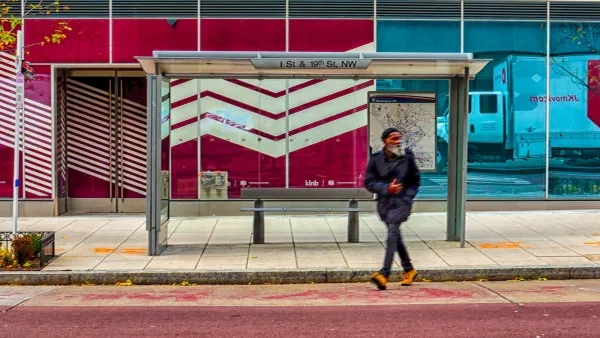
Commentary: Fewer Bus Stops Can Mean Better Service
Effective bus stop balancing can make buses faster while preserving accessibility.

Wow, These Bus Stops are Close Together! The Case for Bus Stop Balancing.
Appropriate bus stop spacing keeps the bus moving and ensures people get where they need to be in a reliable amount of time.

Planetizen Federal Action Tracker
A weekly monitor of how Trump’s orders and actions are impacting planners and planning in America.

Amtrak, CN end decades-long dispute with eight-year agreement
The new operating agreement establishes an updated framework for the companies to work together, including processes to resolve disputes.

Judges permit Denver to divert 77,000 acre feet from the Colorado River for reservoir expansion
Overuse and climate change have caused the Colorado River’s water levels to plummet.

NYC DOT wants faster, more permanent street upgrades
The city is examining ways to build more concrete infrastructure without getting entangled in 'decades-long' projects.

'Something we’ve never seen before:' rising utility rates could strain city finances nationwide
Data centers, climate change and other factors have caused utility rates in the United States to increase by 38% since 2020.

Trump to overrule local leaders, lease millions of acres of America’s Pacific Island territories’ seafloors to mining companies
International law says that the Indigenous people of America’s territories have a right to prior and informed consent regarding projects that impact their countries.

FREE Course: Walkable City 1: Why Walkability?
After describing his path towards focusing on walkability as the essence of good planning, Jeff Speck marches through his five principal reasons for making more walkable places.
Reinventing Malls: Planning Alchemy—Turning Gray Fields Into Gold
The course focuses on the opportunities and imperatives that shape reinvention of mall sites.

Harvard University Graduate School of Design
KFH Group Inc.
Greater Baltimore Committee
The Architects Foundation
University of Cincinnati Online
The Pocatello Development Authority
The Urban Renewal Agency of the City of Pocatello