The 100,000 daily riders who depend on Detroit's bus system have been feeling the effects of public transportation cuts: commute times have doubled, paychecks have suffered. But Quin Klinefelter reports the worst may be yet to come.


Faced with a potential financial crisis, Detroit is looking to make sharp cuts to public transit services. Management of the system has been turned over to a private company and a new CEO, Ronald Freeland, has been appointed to Detroit's Transportation Department. Decisions that may be based in budgetary pragmatics at the state level are taken personally at the rider level:
"They don't care about low-income people or people that do catch the bus, as far as going to school or going back and forth to work," says one rider who's commute time has gone from two hours to four.
Freeland points out that Detroit's population has diminished and the quantity of buses running needs to reflect that. The cost of maintaining, storing and fueling the current fleet of buses will be considered as a state financial review team makes final decisions in the coming month.
Thanks to Jessica Brent
Read the full story: Commuters Suffer as Detroit Cuts Bus Service
DIY Bus Company Delivers Badly Needed Transit Service in Detroit
NationSwell tells the story of the Detroit Bus Company, which provides free transit services to neighborhoods in need around Detroit.

Learning loss and urban schools, part 2
Did test scores in progressive cities drop more post-COVID than test scores in moderate ones?
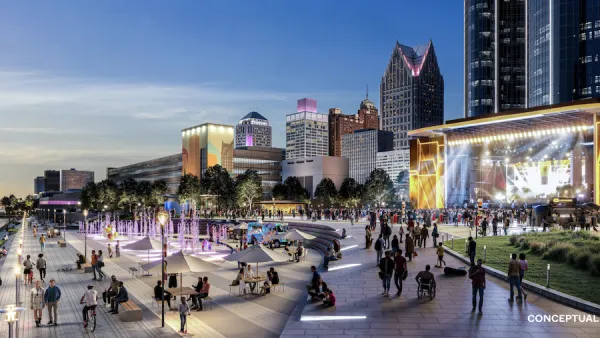
Detroit to transform waterfront with $2.2 billion investment
Developers will convert about 18 acres of unused parking lot space into civic spaces.

Planetizen Federal Action Tracker
A weekly monitor of how Trump’s orders and actions are impacting planners and planning in America.

Eastern Nebraska is running out of electricity
Data centers and electrification are straining eastern Nebraska’s grid, throttling economic development.

Move over, LA: St. Louis gears up for Olympics, invests millions in downtown redevelopment
The Missouri city will host the 2028 Olympic soccer group stage and knockout matches.

Dallas releases zoning code overhaul to officials
The drafted overhaul is over 400 pages long.

NYC renovations for dangerous, ‘mercilessly crammed’ street delayed until 2027
Construction was supposed to begin this fall.

San Diego’s Midway Rising project gets greenlight from city council
The project looks to become the largest affordable housing development in California's history.

FREE Course: Walkable City 1: Why Walkability?
After describing his path towards focusing on walkability as the essence of good planning, Jeff Speck marches through his five principal reasons for making more walkable places.
Reinventing Malls: Planning Alchemy—Turning Gray Fields Into Gold
The course focuses on the opportunities and imperatives that shape reinvention of mall sites.

City of Rosemead
Rutgers University, Edward J. Bloustein School of Planning and Public Policy
One Hundred Miles
University of Michigan School for Environment and Sustainability (SEAS)
Hunter College, City University of New York (CUNY)
The Architects Foundation
City of Cambridge
The Pocatello Development Authority
The Urban Renewal Agency of the City of Pocatello