A successful agriculture program in Southern California introduces farming as a viable career choice to suburban students.


Jason Margolis reports on the latest venture to engage the next generation in farming: The Buena Park High School's agriculture program. The high school program has partnered with Future Farmers of America to "Get more minority high school students, often immigrants, interested in running the farm. That includes kids who have no family background in agriculture and live in urban areas like Buena Park, California."
The program is an opportunity for the urban high school students, most of whom have no prior experience in farming, yet recognize that in "most American farms: White farmers own the land, while Latinos do the hard, manual labor. According to the US Census, Hispanics are the ‘principal operators’ of less than three percent of the nation’s farms."
The agricultural program encourages the "students to take pride in the people harvesting the crops, but also know there are other jobs on the farm too." According to high school teacher Jessica Fernandes, the program also provides agricultural college scholarship opportunities not available to students who have not completed farming classes.
Read the full story: Solving America’s Farming Crisis Involves Our Urban High Schools
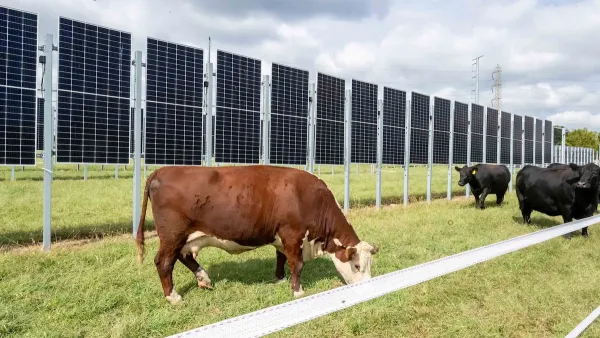
New Jersey Agrivoltaic Project Combines Solar Energy With Farming
A Rutgers University-New Brunswick demonstration farm will evaluate solar array designs to understand how they can best support grazing and agriculture on the same site.
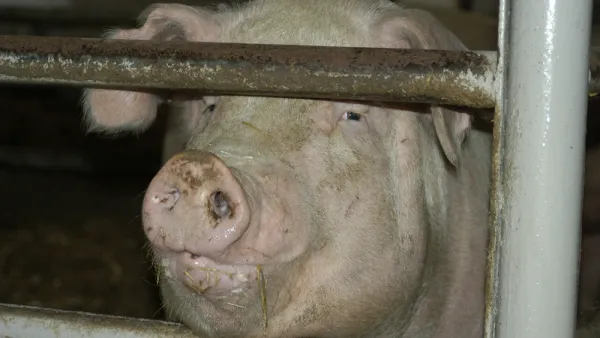
When Pennsylvania's 'Right to Farm' Means Living With the Pigs Next Door
New residents to formerly agricultural area are trying to shut down a hog-feeding operation, but so far without much success.

The Real Cost of Clean Water in One Kansas Town
Pretty Prairie has water with very high levels of nitrates, and lots of farmers that need to use nitrates if they want to keep the local economy going.

Planetizen Federal Action Tracker
A weekly monitor of how Trump’s orders and actions are impacting planners and planning in America.

California plans to bury El Niño’s downpour
If the state plays its cards right, it may be able to store a billion acre-feet of El Niño’s water in aquifers.

Desperate measures: Advocates weigh draining Lake Powell to fill Colorado River
Draining the reservoir could reduce evaporation losses by a couple hundred thousand acre-feet.

Mamdani’s pied-à-terre tax survives legal challenge
A panel of judges found that the plaintiffs failed to demonstrate injury as a result of New York City's implementation of the tax.

Eastern Nebraska is running out of electricity
Data centers and electrification are straining eastern Nebraska’s grid, throttling economic development.

Seattle passes record-breaking transit services expansion
Proposition 1 will double the city’s transit tax to add 95,000 more bus trips and preserve 180,000 bus trips annually.

FREE Course: Walkable City 1: Why Walkability?
After describing his path towards focusing on walkability as the essence of good planning, Jeff Speck marches through his five principal reasons for making more walkable places.
Reinventing Malls: Planning Alchemy—Turning Gray Fields Into Gold
The course focuses on the opportunities and imperatives that shape reinvention of mall sites.

City of Rosemead
Rutgers University, Edward J. Bloustein School of Planning and Public Policy
One Hundred Miles
University of Michigan School for Environment and Sustainability (SEAS)
Hunter College, City University of New York (CUNY)
The Architects Foundation
City of Cambridge
Montrose County
The Pocatello Development Authority