The recently rejected proposal for a new Museum of the American Revolution in Philadelphia failed to live up to the spirit of that seminal event, writes Nathaniel Popkin.


Nathaniel Popkin pens a scathing review of architect A.M. Stern’s recently proposed (and subsequently rejected) designs for the city’s new Museum of the American Revolution. In reviewing the building, Popkin does a good job of establishing the difficult dynamics that can arise when designing with a sensitivity to historic context—especially in a city with as rich a history as Philadelphia.
“Since winning the commission, Stern has continuously implied that the only relevant context for the museum is Independence Hall and the few other buildings of its era nearby. This is willful blindness.”
In the end, says Popkin, the proposed brick box design “is a lost chance, in an era of protest, to make the American uprising feel relevant and inspiring today.”
“…Stern's historicism forces us to look backward through the mist of nostalgia to confront our seminal Revolution. This is blatantly dishonest. Not only was the Revolution messy, as Philadelphia's leading historians tell us, but many of its essential questions remain unresolved. In creating a museum to honor that legacy, we mustn't sell ourselves or our city short.”
Read the full story: Design revolution needed

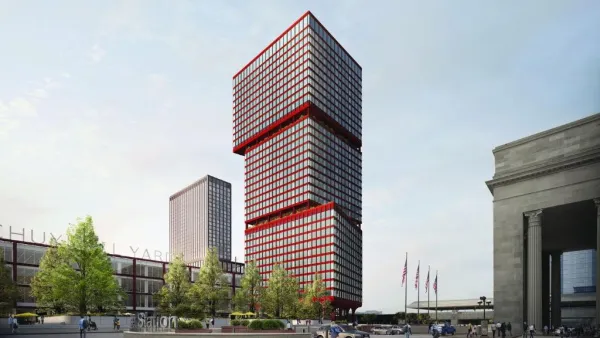
Striking New Towers Coming to Philadelphia's Schuylkill Yards
Brandywine Realty Trust is making a statement with this contemporary take on the corporate high rise.

Philadelphia lawmakers fight to save 'Chinatown Stitch' from Trump cuts
The freeway cap project, approved and funded under the Biden administration, is now in jeopardy after the federal government rescinded all but $8 million in funding.
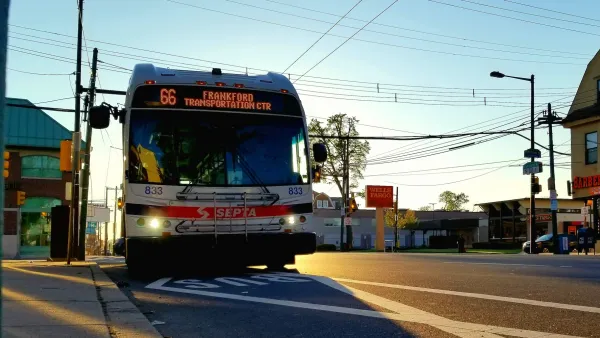
SEPTA's bus-mounted lane enforcement cameras cut travel times by up to 6%
The AI-assisted cameras have issued nearly 200,000 citations to drivers blocking bus lanes.

Planetizen Federal Action Tracker
A weekly monitor of how Trump’s orders and actions are impacting planners and planning in America.

‘Going backwards:’ Baltimore mayor, students rally against state's transit funding plan
Maryland's proposed six-year plan provides no funding for Baltimore’s BMORE bus program and reduces its road maintenance funding.

Detroit to transform waterfront with $2.2 billion investment
Developers will convert about 18 acres of unused parking lot space into civic spaces.

U.S.-Iran war may have ‘devastating’ impact on cost to warm homes
Vermont and Maine residents may see a 76% increase in the cost of warming their homes this winter.

Senate bill would ‘overhaul’ environmental permitting laws
Under the proposed act, government agencies would also not be able to suspend or rescind permits after granting them.

Exemption applications for NYC’s pied-à-terre tax see 55% success rate
The city sent nearly 40% of its initial pied-à-terre tax warnings erroneously.

FREE Course: Walkable City 1: Why Walkability?
After describing his path towards focusing on walkability as the essence of good planning, Jeff Speck marches through his five principal reasons for making more walkable places.
Reinventing Malls: Planning Alchemy—Turning Gray Fields Into Gold
The course focuses on the opportunities and imperatives that shape reinvention of mall sites.

One Hundred Miles
County of Mendocino
planning NEXT
The Architects Foundation
University of Cincinnati Online
Montrose County
Northern Illinois Transit Authority (NITA)
The Pocatello Development Authority