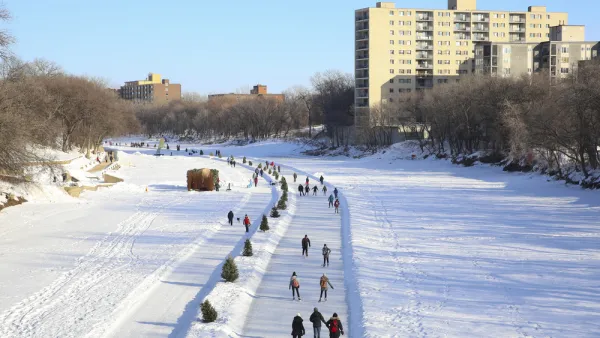
If you need a little misery-loves-company commiseration on winter, Hazel Borys shares some pics from Winnipeg, the coldest big city on earth. How this winter city deals with the polar vortex is something we may all need to get used to.


"Last Friday, our nine-year-old came home from school talking nonstop Olympics. He went on for awhile about 2010 medal counts, with Canada taking home 14 golds in Vancouver, the record for any country at Winter Olympics. The deep polar vortex we’ve been trudging through this winter has to have some silver lining, so perhaps being better at Winter Olympics is part of the payoff for our wintry country. #WeAreWinter. However, I couldn’t help but thinking about Suburban Nation
Hazel Borys goes on to talk about how Canadian city planning differs from American, and how the two have differed over time. Borys uses a photo essay to point out a few differences in how Canadians manage to stay active during the winter, even in suburban neighborhoods. For instance: "Students stay indoors for recess when the wind chill reaches -28 degrees Celsius. Otherwise, it’s snowy fun, with winter gear policies enforced."
Read the full story: Connected? Walkable urbanism, active kids, and Olympic gold
Goodbye, Winter: Until Next Time, a Few Reminders on Lovable Winter Cities
While winter cities may spend most of their brand management on showcasing regional winter amenities, the greatest winter cities provide delight on the neighborhood scale.
Walkable Winter Cities: Feasibility While Freezing
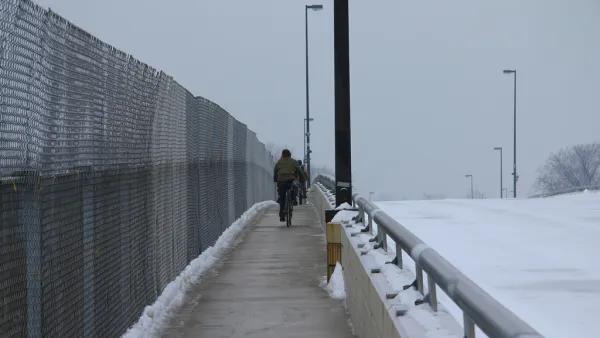
"It's too cold to walk here" is often the response to the subject of livability in northern climes. Hazel Borys hails from the third coldest city of its size on earth and talks walkable winter cities.

3 Good Reasons SimCity Should Adopt a Form-Based Code
And an update from Codes Study about the 600 places that really are upping their game with form-based codes.

Desperate measures: Advocates weigh draining Lake Powell to fill Colorado River
Draining the reservoir could reduce evaporation losses by a couple hundred thousand acre-feet.

Eastern Nebraska is running out of electricity
Data centers and electrification are straining eastern Nebraska’s grid, throttling economic development.

Malls are becoming the midtowns of the future
Mall and office park redevelopments are a generational opportunity to create new nodes of urbanity.

NYC breaks ground on anti-flooding infrastructure project
New York City's new system will reduce stormwater flows to local sewers by 90%.

One Kentucky town’s secret to affordable housing
The Smoketown Community Land Trust has already built seven affordable homes for community members.

Houston gains petal-shaped cooling infrastructure to make streets more ‘delightful’
The city has installed the pavilions along 15 blocks in Houston.

FREE Course: Walkable City 1: Why Walkability?
After describing his path towards focusing on walkability as the essence of good planning, Jeff Speck marches through his five principal reasons for making more walkable places.
Reinventing Malls: Planning Alchemy—Turning Gray Fields Into Gold
The course focuses on the opportunities and imperatives that shape reinvention of mall sites.

City of Rosemead
Rutgers University, Edward J. Bloustein School of Planning and Public Policy
One Hundred Miles
University of Michigan School for Environment and Sustainability (SEAS)
Hunter College, City University of New York (CUNY)
The Architects Foundation
City of Cambridge
Montrose County
The Pocatello Development Authority