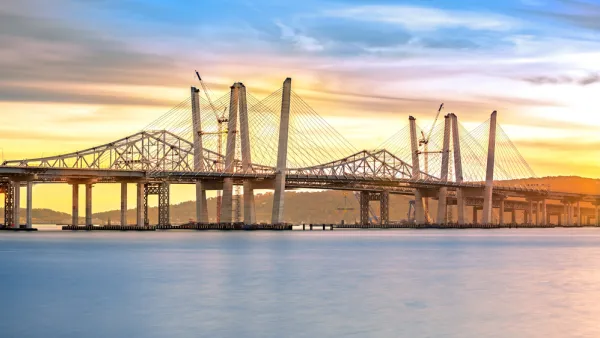
What lifts up to 1,750 tons? Goodbye "Left Coast Lifter". Hello "I Lift New York". The massive crane was barged 6,000 miles through the Panama Canal to begin construction of the replacement Tappan Zee Bridge, having completed the Bay Bridge job.


The name change is only appropriate for one of the world's largest floating cranes. It is now docked at a Port Authority of N.Y. and N.J. facility in Jersey City after its one-month journey from San Francisco Bay where it helped build the new East Span of the Bay Bridge that opened Sept. 2.
Next job: Tear down the existing Tappan Zee Bridge, operated by the New York State Thruway Authority, and "build the new bridge’s structure and foundation," writes Rebecca Harshbarger. "It is expected to shorten construction time, and cut costs in building because it is so powerful."
“The Lift New York super crane can lift the equivalent of twelve Statues of Liberty at once,” said (N.Y.) Governor Cuomo in a statement (Jan. 30).
Passage through the Panama Canal was no easy task. Watch The New York Times video showing "the twin-boom Left Coast Lifter, which is said to be the world’s largest floating crane, lifted roughly 54 feet above Pacific sea level in two stages at the Panama Canal’s Miraflores Locks," writes
FULL STORY: ‘I Lift New York’ crane ends 6,000-mile trip to rebuild Tappan Zee Bridge

Gov. Cuomo's 'Robert Moses Wish List' Continues to Grow—But Where's the Payment Plan?
The New York governor continues his tour of New York, promoting his big ticket capital agenda, yet not suggesting any means to pay for them. Worse yet, he restricts new funding options, like increased tolls, adding costs to the transportation budget.
Tappan Zee Scores Largest Ever TIFIA Loan, But How Will It Be Repaid?
New York State received good news on Oct. 31: A $1.6 billion loan has been approved toward the $4 billion replacement of the Tappan Zee Bridge. The remainder will be borrowed from the private sector. A commission will offer ways to repay the loans.
$4 Billion Later, the New Tappan Bridge More Crowded Than Ever
Traffic data shows more and more cars and trucks using the new Tappan Zee Bridge in 2019, in what looks like an obvious case of induced demand.

The state-sanctioned urbicide of Austin
People don’t kill cities. Freeways do.

US to reduce Colorado River water deliveries to Mexico
A new Colorado Treaty amendment reduces Mexico’s Colorado River water allocation by 250,000 acre feet.

New Jersey’s second-largest city bans standalone data centers
Jersey City will continue to allow co-location facilities, such as those meant for research institutions that store their own data.

Amtrak not solely to blame for New Jersey commuter rail's unreliability, report finds
A new study from the Garden State Initiative found that NJ Transit’s budget grew 20% across a 4 year period, but reliability declined significantly over the same period.

EPA erases limits on planet-warming pollution from power plants
Under Monday’s plan, power plants would still have some limits on how much mercury, arsenic and other contaminants they can emit.

Phoenix announces new on-demand transit service, more frequent RAPID buses
Both new services will launch in October, and are part of Phoenix's Project Effective Access Solutions for Easing Congestion.

FREE Course: Walkable City 1: Why Walkability?
After describing his path towards focusing on walkability as the essence of good planning, Jeff Speck marches through his five principal reasons for making more walkable places.
Reinventing Malls: Planning Alchemy—Turning Gray Fields Into Gold
The course focuses on the opportunities and imperatives that shape reinvention of mall sites.

Eagle County Government
Harvard University Graduate School of Design
Nashville Planning Department
The Architects Foundation
University of Cincinnati Online
The Pocatello Development Authority
The Urban Renewal Agency of the City of Pocatello
Journal of the American Planning Association