Developers at Google and Amazon are among those working diligently to produce a near future full of autonomous cars and delivery devices. Economics professor Casey B. Mulligan suggests such advances will increase the value of urban land.


"As technology helps with moving goods and people more cheaply, it might seem that urban real estate would give up some of its price premium because distance becomes less of an obstacle to economic transactions," writes Mulligan. But the University of Chicago professor argues that such advances could have the opposite effect.
"New technologies might allow [people] to use urban properties on a part-time basis, or use less urban property to accomplish the same tasks, which would make urban property more valuable." And, he adds, technologies such as driverless cars and delivery drones will likely emerge in urban areas first.
"Thus, while cities already give their residents access to more goods and services, technology may further shift that advantage and thereby increase urban property values."
Read the full story: Robots and Property Values

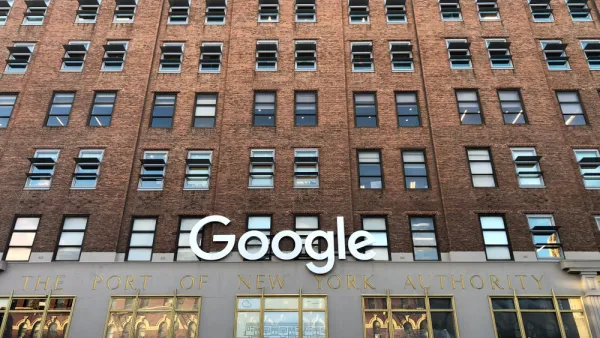
Big Tech Bets on the Big Apple
Amidst the uncertainty of the pandemic, the four biggest U.S. technology companies have leased or bought enough office space in New York City for 22,000 employees.
Google Tax to Appear on November Ballot in Mountain View, California
If a majority of the city's voters approve the city-sponsored ballot measure, business license fees will change from a flat $30 annual fee to a new tax based on the number of employees, with the largest employer, Google, to pay $3.3 million.

Drone Delivery Reaches the Burrito Phase
Delivery-by-drone continues to make strides to becoming a feasible reality, as testing in rural Australia has seen burritos fly through the air from restaurant to customers' back yards.

Planetizen Federal Action Tracker
A weekly monitor of how Trump’s orders and actions are impacting planners and planning in America.

Amtrak, CN end decades-long dispute with eight-year agreement
The new operating agreement establishes an updated framework for the companies to work together, including processes to resolve disputes.

Judges permit Denver to divert 77,000 acre feet from the Colorado River for reservoir expansion
Overuse and climate change have caused the Colorado River’s water levels to plummet.

SEPTA to bring nearby frequent transit to over 1 million new riders as part of decade-long plan
The agency's Accelerate plan will also bring frequent transit to twice the amount of jobs that are currently located near it.

NYC plants over 18,000 trees, the most new foliage in a decade
Many of the trees were planted in communities vulnerable to extreme heat.

New bill requires California data center developers to create water scarcity plans
Gov. Gavin Newsom recently signed 7 bills intended to give California communities more information about the impact of proposed data centers.

FREE Course: Walkable City 1: Why Walkability?
After describing his path towards focusing on walkability as the essence of good planning, Jeff Speck marches through his five principal reasons for making more walkable places.
Reinventing Malls: Planning Alchemy—Turning Gray Fields Into Gold
The course focuses on the opportunities and imperatives that shape reinvention of mall sites.

City of Wisconsin Rapids
Harvard University Graduate School of Design
KFH Group Inc.
The Architects Foundation
University of Cincinnati Online
The Pocatello Development Authority
The Urban Renewal Agency of the City of Pocatello