A push by the Los Angeles Unified School District to increase its supply of healthy and locally-produced foods is paying dividends for area farmers and businesses.


"In a groundbreaking effort, the nation's second-largest school district is using its enormous purchasing clout to support local farmers and businesses," writes Teresa Watanabe. "In just two years, the district has boosted its local purchases of fruit and vegetables from 9% of its $20-million annual produce budget to 75% today. L.A. Unified now buys locally for at least 50% of its overall $125-million food budget, about double the proportion of two years ago, according to David Binkle, the district's food services director."
"The preference for products that originate within about 200 miles of Los Angeles was formalized last year by the Board of Education, which also directed the district to purchase 5% of its produce from small-to-medium-sized farmers."
"The leadership LAUSD has shown in this area has resonated not only locally but also nationally," said Paula Daniels, founder and chairwoman of the Los Angeles Food Policy Council. "By expressing support for these values through their purchases, the impact all along the food chain is profound."
Read the full story: L.A. Unified's local food push is healthy for area economy too http://www.latimes.com/local/la-me-lausd-food-20131124,0,5379419

Identifying and Improving Schools Most In Need of Greening
Los Angeles Unified School District (LAUSD) has developed an index to help identify the schools that are most in need of greening resources.

Los Angeles Parents Demand Greener Schoolyards
With asphalt temperatures reaching as much as 150 degrees, parents and advocates are asking the city’s school district to provide more shade, trees, and other heat mitigation features on its schoolyards and playgrounds.
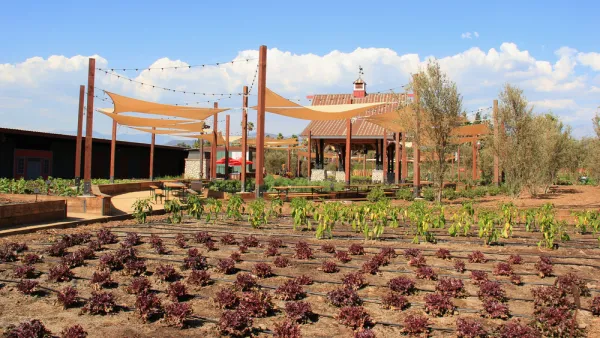
Urban Farming Program Struggles to Sprout
Los Angeles created a tax incentive to promote urban farms on the thousands of vacant lots around the city. So far, the incentive has been given out only four times.

Planetizen Federal Action Tracker
A weekly monitor of how Trump’s orders and actions are impacting planners and planning in America.

California plans to bury El Niño’s downpour
If the state plays its cards right, it may be able to store a billion acre-feet of El Niño’s water in aquifers.

Desperate measures: Advocates weigh draining Lake Powell to fill Colorado River
Draining the reservoir could reduce evaporation losses by a couple hundred thousand acre-feet.

Mamdani’s pied-à-terre tax survives legal challenge
A panel of judges found that the plaintiffs failed to demonstrate injury as a result of New York City's implementation of the tax.

Eastern Nebraska is running out of electricity
Data centers and electrification are straining eastern Nebraska’s grid, throttling economic development.

Seattle passes record-breaking transit services expansion
Proposition 1 will double the city’s transit tax to add 95,000 more bus trips and preserve 180,000 bus trips annually.

FREE Course: Walkable City 1: Why Walkability?
After describing his path towards focusing on walkability as the essence of good planning, Jeff Speck marches through his five principal reasons for making more walkable places.
Reinventing Malls: Planning Alchemy—Turning Gray Fields Into Gold
The course focuses on the opportunities and imperatives that shape reinvention of mall sites.

City of Rosemead
Rutgers University, Edward J. Bloustein School of Planning and Public Policy
One Hundred Miles
University of Michigan School for Environment and Sustainability (SEAS)
Hunter College, City University of New York (CUNY)
The Architects Foundation
City of Cambridge
Montrose County
The Pocatello Development Authority