New "sharrows on steroids" are being tested In the Allston neighborhood of Boston. Are the markings - parallel dashed lines bracketing a bicycle icon - a legitimate improvement on the controversial practice or "an underwhelming innovation"?


"A new set of street markings on Allston’s Brighton Avenue aren’t simply an errant set of dashes installed by city staff with extra paint — they’re part of a national experiment to test innovative bike facilities," writes Martine Powers.
Wanting to boost the bike-friendliness of Brighton Avenue, but without the ability to remove a travel lane or parking, Boston bike czar Nicole Freedman and her staff took inspiration from Peter Furth, civil engineering professor and bike infrastructure expert at Northeastern University, who developed the idea [PDF] for the beefed-up sharrows.
"Some may view the addition of dashed lines to the sides of sharrow icons an underwhelming innovation," notes Powers. "But Freedman said she believes drivers will intuitively see the dashed lines as an indication that they should use the left-hand lane if traffic is free-flowing, leaving a wide berth for cyclists in the right-hand lane it’s not rush hour gridlock."
Read the full story: New ‘sharrows on steroids’ debut on Allston’s Brighton Ave.
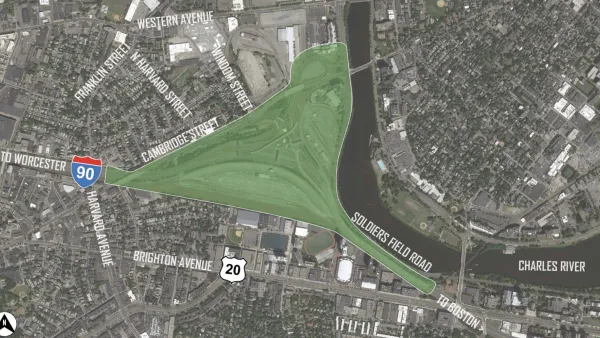
$1.2 Billion in Federal Funding Sought for Boston-Area Road Project
The city of Boston and Massachusetts Department of Transportation have applied to a $5 billion federal grant program aimed at ‘unusually large and complex projects.’
Op-Ed: Postponing Transit in Allston Will Cost Boston
As the state plans a major renovation to the Massachusetts Turnpike, whether an Allston transit hub is built or delayed may determine how effectively the surrounding neighborhood develops.

What a 'Bicycle Stress Map' Reveals About the Streets of Montgomery County
A new map quantifies the stress levels for bike riders on the streets of Montgomery County, Maryland.

Planetizen Federal Action Tracker
A weekly monitor of how Trump’s orders and actions are impacting planners and planning in America.

California plans to bury El Niño’s downpour
If the state plays its cards right, it may be able to store a billion acre-feet of El Niño’s water in aquifers.

Desperate measures: Advocates weigh draining Lake Powell to fill Colorado River
Draining the reservoir could reduce evaporation losses by a couple hundred thousand acre-feet.

Los Angeles just elected an urban planner as its mayor
Transportation analysts are optimistic that Raman will be more aggressive in addressing transit issues than Bass.

Mamdani’s pied-à-terre tax survives legal challenge
A panel of judges found that the plaintiffs failed to demonstrate injury as a result of New York City's implementation of the tax.

Eastern Nebraska is running out of electricity
Data centers and electrification are straining eastern Nebraska’s grid, throttling economic development.

FREE Course: Walkable City 1: Why Walkability?
After describing his path towards focusing on walkability as the essence of good planning, Jeff Speck marches through his five principal reasons for making more walkable places.
Reinventing Malls: Planning Alchemy—Turning Gray Fields Into Gold
The course focuses on the opportunities and imperatives that shape reinvention of mall sites.

City of Rosemead
Rutgers University, Edward J. Bloustein School of Planning and Public Policy
One Hundred Miles
University of Michigan School for Environment and Sustainability (SEAS)
Hunter College, City University of New York (CUNY)
The Architects Foundation
City of Cambridge
Montrose County
The Pocatello Development Authority