Not just anyone can (legally) perform for the millions of passengers who ply Paris's mammoth subway system every day. Liz Alderman looks at the competitive process to land a highly coveted, and potentially lucrative, permit to play Paris Métro.


"With five million passengers a day, 303 stations and miles upon miles of hallways, “[the Paris Métro has] become the biggest scene in Paris for musicians,” said [Antoine Naso, Métro's artistic director], an energetic man clad in black jeans and leather boots who established a program to ensure live, quality music throughout the Métro 16 years ago."
"About 2,000 people apply annually for tryouts held in spring and autumn, judged by Mr. Naso, two Métro employees and two members of the public," explains Alderman. "Of the 300 permits awarded, about half are allocated to veteran badge holders, with the rest going to newcomers."
“'We have a high level of artists,' said Mr. Naso, who estimated that he had judged nearly 20,000 auditions since 1997, when the licensing program started. 'Producers and recording houses are scouting the Métro more and more,' he said. 'Sometimes, a star is born.'”
Read the full story: Trying to Elevate the Sounds Competing With Subterranean Clatter

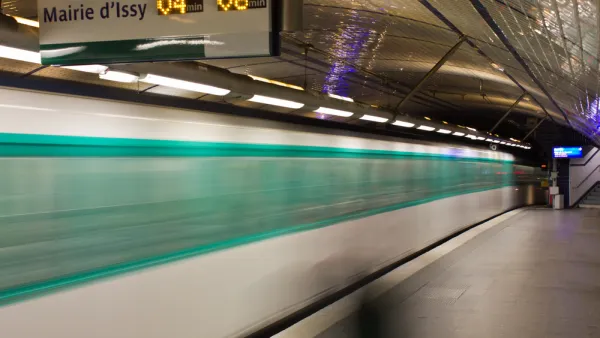
8 Lessons from the Paris Metro
Transportation planner Dan Malouff shares eight insights into what makes the Paris Metro one of the world's great subways.
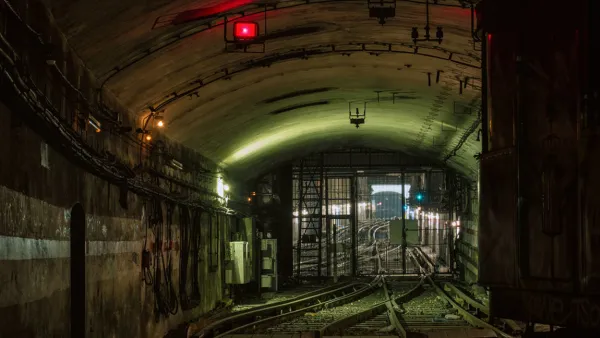
Reimagining Paris’s Derelict Métro Stations
Parisian mayoral candidate Nathalie Kosciusko-Morizet's proposal for the city’s abandoned train stations can be safely described as awesome. The designs are still a dream, but the city of lights is a good place for creative activity.
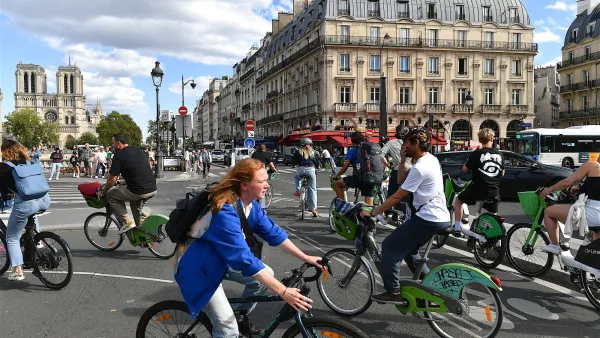
Biking in Paris grew by 240% in 5 years
The city saw a significant rise in bike use thanks to data-driven policy changes.

Amtrak, CN end decades-long dispute with eight-year agreement
The new operating agreement establishes an updated framework for the companies to work together, including processes to resolve disputes.

Judges permit Denver to divert 77,000 acre feet from the Colorado River for reservoir expansion
Overuse and climate change have caused the Colorado River’s water levels to plummet.
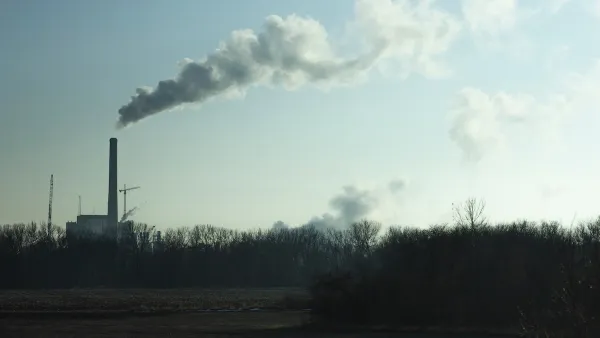
Nation's most wind-powered state turns to coal as data centers increase energy demand
For the first time in decades, Iowa has increased its generation of coal power.

Boston has spent millions making the Green Line more accessible — and there’s no end in sight
While the city has invested millions into expanding and adding platforms to the Green Line to make it more accessible, new train cars set to arrive next year will be too tall for disabled passengers to board without raising the current platforms.

Idaho may see an 18% drop in federal surface transit funding — the largest estimated cut in the US
Transit systems in rural communities are much more reliant on federal funding to provide their services.

How ‘post-disaster gentrification’ alters neighborhoods after natural calamities
After hurricanes, fires or other calamities, the original residents of a community are often replaced by younger, wealthier residents.

FREE Course: Walkable City 1: Why Walkability?
After describing his path towards focusing on walkability as the essence of good planning, Jeff Speck marches through his five principal reasons for making more walkable places.
Reinventing Malls: Planning Alchemy—Turning Gray Fields Into Gold
The course focuses on the opportunities and imperatives that shape reinvention of mall sites.

City of Wisconsin Rapids
Harvard University Graduate School of Design
KFH Group Inc.
The Architects Foundation
University of Cincinnati Online
The Pocatello Development Authority
The Urban Renewal Agency of the City of Pocatello