"The Roaring 'Twenties", an interactive soundscape created by a historian of sound, technology and cultures of listening at Princeton, seeks to immerse people in the sounds of 1929 New York City, and demonstrate that noise pollution is nothing new.


Noise pollution isn't a new problem for New York City. At least as far back as the 1920s, researchers were trying to measure and mitigate the city's sounds.
"In 1929, New York’s Noise Abatement Commission outfitted a truck with microphones and sound recording devices to measure the city’s din," writes Emily S. Rueb. "Researchers made more than 10,000 observations on the truck’s 500-mile journey past construction sites with billowing steam shovels and pounding pile drivers, underneath screeching elevated trains and past the cluster of electronics shops blaring music in Lower Manhattan’s 'Radio Row.'”
A new web site seeks to immerse listeners in those sounds.
"'The Roaring ‘Twenties,' as it is called, was created by Emily Thompson, a historian of sound, technology and cultures of listening at Princeton University who has spent many years thinking about how best to present sonic complaints in the Municipal Archives of the City of New York and videos from the Moving Image Research Collections of the Libraries of the University of South Carolina with the hope of getting people into a 1929 state of mind."
“It’s my attempt to build a time machine,” she said.
Read the full story: Listening to the Roar of 1920s New York
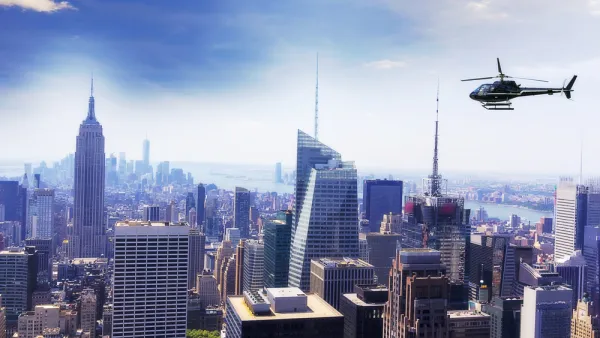
Helicopter Noise Complaints Surge in New York
Residents argue the city and state must do more to regulate the hundreds of flights that criss-cross the area on a daily basis.
Using Tech to Control Noise Pollution
Several cities are piloting programs that use machine learning to identify and understand urban noise patterns and enforce noise ordinances.
Learning About the City by Running for Office
When you are trying to get people's attention, a city feels very different.

Planetizen Federal Action Tracker
A weekly monitor of how Trump’s orders and actions are impacting planners and planning in America.

Eastern Nebraska is running out of electricity
Data centers and electrification are straining eastern Nebraska’s grid, throttling economic development.

Study reveals best places in the U.S. for cycling, walking
New research from Streetlight Data examines bicycle and pedestrian miles per capita in the 100 largest U.S. cities by population.

Next-generation nuclear reactors are coming to Texas
The reactors will not require towering containment structures thanks to new safety features.

California distributes $1.3 billion to prevent transit service cuts, bolster projects
Twenty-eight projects across California received a portion of the funding.

Pennsylvania Democrats have 15 affordability, clean energy bills for flipped state Senate
Bills in consideration include a bill supporting geothermal energy and a bill supporting solar on warehouses.

FREE Course: Walkable City 1: Why Walkability?
After describing his path towards focusing on walkability as the essence of good planning, Jeff Speck marches through his five principal reasons for making more walkable places.
Reinventing Malls: Planning Alchemy—Turning Gray Fields Into Gold
The course focuses on the opportunities and imperatives that shape reinvention of mall sites.

City of Charlotte
City of Rosemead
Rutgers University, Edward J. Bloustein School of Planning and Public Policy
University of Michigan School for Environment and Sustainability (SEAS)
Hunter College, City University of New York (CUNY)
The Architects Foundation
City of Cambridge
The Pocatello Development Authority
The Urban Renewal Agency of the City of Pocatello