In the Toronto area, the region's suburbs have evolved in ways that make them fundamentally different from their outdated postwar image. Yet the ways we think and talk about the suburbs haven't kept up with this new reality.


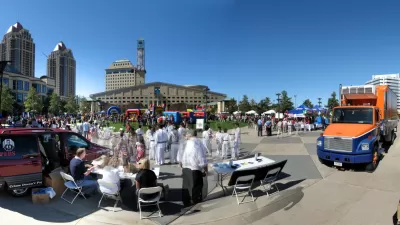
"The suburbs have the region’s majority share of population and job growth and are home to major infrastructures such as the airport and universities," say Sean Hertel and Roger Keil. "On these bases suburbia can no longer be considered subordinate to the City of Toronto. But still it is. Prejudices have power over facts – clouding our view of what the suburbs truly have become and why, most importantly, that should matter."
Hertel and Keil, who have been engaged in a three-year effort to develop "new approaches for planning, building, servicing and governing Toronto’s ever-growing and diversifying periphery", have just issued a new report that describes their recommendations for shaping the region's suburbs for their "urban future".
"The suburbs have become, like the city centres before them, the new arenas for forming and contesting politics, modes of governance, ways of life, and the forms and notions of community," they conclude. "Taken one step further, the suburb has become the new city. And a new kind of city – a 'regional city.'”
Read the full story: Look for Toronto’s urban future in the booming suburbs

Reconsidering Toronto's Suburbs
Toronto's suburbs have often been dismissed as bland and banal. A closer look, however, reveals a diverse, complex landscape whose rapid changes have profound implications for the metropolis as a whole.
Suburbs Left Out of Toronto Transit Plan
Critics in Toronto are blasting a new transit plan from Mayor Rob Ford that they say overlooks the city's suburban areas.
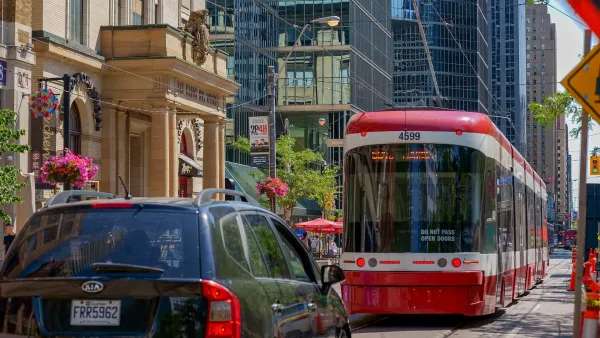
Toronto Man Beats Streetcar on Foot to Highlight Traffic Delays
Runner Mac Bauer says he hopes his project spurs the city to improve transit speed and reliability.

Planetizen Federal Action Tracker
A weekly monitor of how Trump’s orders and actions are impacting planners and planning in America.

‘Going backwards:’ Baltimore mayor, students rally against state's transit funding plan
Maryland's proposed six-year plan provides no funding for Baltimore’s BMORE bus program and reduces its road maintenance funding.

Detroit to transform waterfront with $2.2 billion investment
Developers will convert about 18 acres of unused parking lot space into civic spaces.

Michigan Senate votes to revise 'lax' dam safety laws
A Bridge Michigan investigation found more than 100,000 Michigan residents live in the floodpath of a high or significant-hazard dam.

NYC’s landfills will soon overflow — expanding them invites health risks
In as little as 16 years, New York City will have to find new places to dump its trash.

This Boston neighborhood is filling its roads with obstacles — intentionally
Somerville is embracing ‘extreme street makeovers’ to make its roads safer for pedestrians and cyclists.

FREE Course: Walkable City 1: Why Walkability?
After describing his path towards focusing on walkability as the essence of good planning, Jeff Speck marches through his five principal reasons for making more walkable places.
Reinventing Malls: Planning Alchemy—Turning Gray Fields Into Gold
The course focuses on the opportunities and imperatives that shape reinvention of mall sites.

City of Thousand Oaks
City of Wisconsin Rapids
Harvard University Graduate School of Design
The Architects Foundation
University of Cincinnati Online
Northern Illinois Transit Authority (NITA)
The Pocatello Development Authority
The Urban Renewal Agency of the City of Pocatello