Eric Jaffe of The Atlantic Cities talks with writer Leigh Gallagher about her new book, The End of the Suburbs: Where the American Dream Is Moving, and her opinions on the rapidly evolving American housing market.


A major shift is occurring in suburban and urban environments, highlighted by recent studies on population growth in city centers, shifting attitudes about driving, and rapidly increasing urban home values.
During an interview with Eric Jaffe of The Atlantic Cities, Leigh Gallagher states that although these recent trends are accelerating, it is unrealistic and impractical to assume everyone will want to migrate to an urban setting, but that a “big part of the future will be ‘urban burbs.’ Suburbs that are adapting or already exist in this fashion. Where they have a walkable downtown, a pleasant place to take a stroll and bump into people, and where it's possible to live in closer proximity to the things you need to do everyday.”
Gallagher's new book, The End of the Suburbs: Where the American Dream Is Moving, asserts that there are several reasons why the suburbs were poorly designed, and why they are currently making millions of people people really unhappy. She notes that "somewhere along the way the American Dream morphed from being a dream, an opportunity, to being a house,” but that is no longer the case.
She concludes the interview by stating how far we actually are from this idealized “urban burb” style of living, and that the most important thing for us to do is to follow what current market demand is telling us, and recognize that we can't continue doing what we’ve been doing.
Read the full story: The Suburbs Are Dead, Long Live the Suburbs


Homeownership—American Dream or Nightmare?
Owning a home has long been considered the ultimate aspiration. But social and economic realities mean the stories about and the path to homeownership are not simple and straightforward.
American Home Ownership: Dream Deferred or In Need of Renovation?
While conceding that suburbia, and home construction patterns, will change in the coming decades, a new report from Joel Kotkin argues that the "dream" of suburban American homeownership is alive and well and poised to remain relevant.
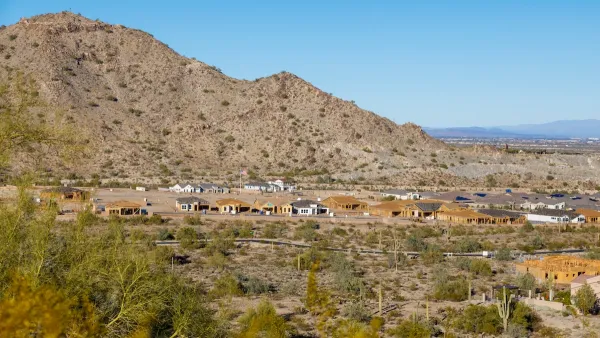
Arizona Overrides Moratorium Imposed due to Water Crisis, Approves up to 60K New Homes
A newly created legal process allows development to proceed if builders agree to bring in renewable water sources and reduce their groundwater use by 25%.

Planetizen Federal Action Tracker
A weekly monitor of how Trump’s orders and actions are impacting planners and planning in America.

Amtrak, CN end decades-long dispute with eight-year agreement
The new operating agreement establishes an updated framework for the companies to work together, including processes to resolve disputes.

Judges permit Denver to divert 77,000 acre feet from the Colorado River for reservoir expansion
Overuse and climate change have caused the Colorado River’s water levels to plummet.

NYC DOT wants faster, more permanent street upgrades
The city is examining ways to build more concrete infrastructure without getting entangled in 'decades-long' projects.

'Something we’ve never seen before:' rising utility rates could strain city finances nationwide
Data centers, climate change and other factors have caused utility rates in the United States to increase by 38% since 2020.

Trump to overrule local leaders, lease millions of acres of America’s Pacific Island territories’ seafloors to mining companies
International law says that the Indigenous people of America’s territories have a right to prior and informed consent regarding projects that impact their countries.

FREE Course: Walkable City 1: Why Walkability?
After describing his path towards focusing on walkability as the essence of good planning, Jeff Speck marches through his five principal reasons for making more walkable places.
Reinventing Malls: Planning Alchemy—Turning Gray Fields Into Gold
The course focuses on the opportunities and imperatives that shape reinvention of mall sites.

Harvard University Graduate School of Design
KFH Group Inc.
Greater Baltimore Committee
The Architects Foundation
University of Cincinnati Online
The Pocatello Development Authority
The Urban Renewal Agency of the City of Pocatello