The 'biggest regional planning effort in a generation' is providing residents of twelve Northeast Ohio counties with an opportunity to discuss how the area can leverage its existing infrastructure rather than continuing to sprawl.


"Northeast Ohio faces a grim future if it continues sprawling as usual," writes Steven Litt. "But it has options that could dramatically improve its economy, social equity, and environment if it channels development back toward cities that are hollowing out today."
"That’s the basic thrust of a quartet of development scenarios being offered by the Northeast Ohio Sustainable Communities Consortium as choices for public debate over the next two weeks in the latest phase of the biggest regional planning effort in a generation."
"Funded by a $4.25 million grant from the federal Department of Housing and Urban Development, plus $2.4 million in local matching funds, the sustainability group is in the final six months of a three-year effort to help Northeast Ohio fashion a rational vision for the future rather than blindly continue current trends."
Read the full story: Sustainability consortium seeks public response on alternatives to sprawl in Northeast Ohio

Regional Plan Recommends Three Elements for Creating a Thriving Northeast Ohio
Northeast Ohio's largest regional planning effort in a generation recommends infill development, transit expansion, and land conservation as the essential elements for ensuring the area's future success.
As the State Abandons Public Transit, Is a Regional Solution Possible for Northeast Ohio?
Many states cover around 20 percent of the costs of public transit. In Ohio, that figure has dropped to 1 percent.
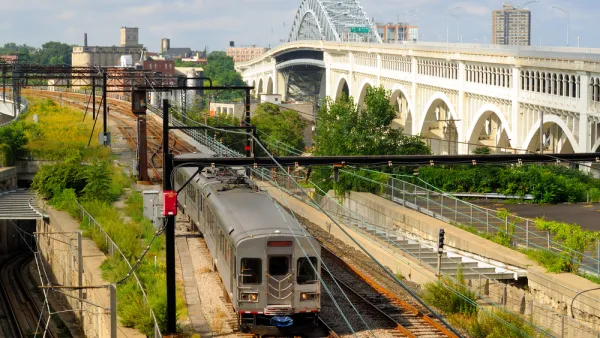
Calls for a Regional Transit System in Northeast Ohio
The Cleveland Plain Dealer lays out the complicated path toward a regional transit system similar to Chicago's in the Cleveland area. The call for reform comes as existing transit is cutting service and raising fares.

Planetizen Federal Action Tracker
A weekly monitor of how Trump’s orders and actions are impacting planners and planning in America.

California plans to bury El Niño’s downpour
If the state plays its cards right, it may be able to store a billion acre-feet of El Niño’s water in aquifers.

Chicago breaks ground on $3 billion megadevelopment
The new neighborhood, titled Foundry Park, will one day host 3,700 residences.

City officials are dumping billions of gallons of sewage into the Chicago River
This year, the Racine Avenue sewage pumping station has poured over 10 billion gallons of sewage into the Chicago River.

Move over, LA: St. Louis gears up for Olympics, invests millions in downtown redevelopment
The Missouri city will host the 2028 Olympic soccer group stage and knockout matches.

Satanic place names
From streams and lakes to valleys and canyons, I mapped more than 1,000 places named after the Devil.

FREE Course: Walkable City 1: Why Walkability?
After describing his path towards focusing on walkability as the essence of good planning, Jeff Speck marches through his five principal reasons for making more walkable places.
Reinventing Malls: Planning Alchemy—Turning Gray Fields Into Gold
The course focuses on the opportunities and imperatives that shape reinvention of mall sites.

City of Rosemead
Rutgers University, Edward J. Bloustein School of Planning and Public Policy
One Hundred Miles
Hunter College, City University of New York (CUNY)
The Architects Foundation
University of Cincinnati Online
City of Cambridge
Montrose County
The Pocatello Development Authority