This summer marks a key moment in the effort to transform the Los Angeles River from eyesore to amenity. A newly announced greenway plan and much-delayed U.S. Army Corps of Engineers feasibility study could fundamentally change the river's course.


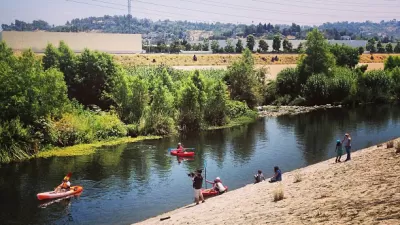
Plans announced yesterday to complete a continuous bike path and greenway along all 51 miles of the Los Angeles river, build a pedestrian, bike and equestrian bridge at a juncture with Griffith park, and, most crucially, a "much-anticipated, much-delayed" U.S. Army Corps of Engineers feasibility study, represent 'a moment of truth' in the river's history, asserts Christopher Hawthorne. "The plans could fundamentally change how the public looks at the river, which has been more of an eyesore than natural amenity since the federal government wrapped much of it in concrete as a flood-control measure beginning in the 1930s."
"There is a sense among longtime river-watchers that the potential for transformative change — and federal help in that effort — has never been greater," he adds. "But optimism is accompanied by worries that Washington won't quite rise to meet the moment."
Read the full story: L.A. River advocates wait for watershed Army Corps study

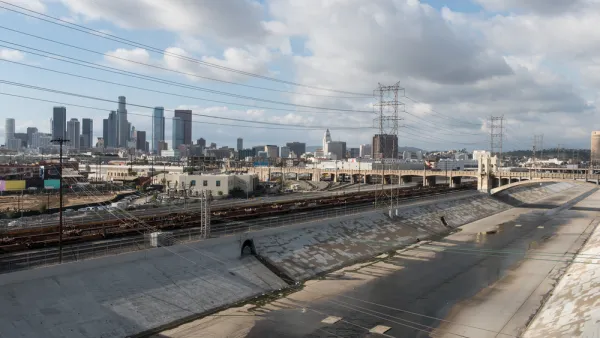
Los Angeles Wants its River Back From the Feds
Regional officials don't think the federal government is doing enough to warrant continued ownership of the Los Angeles River flood control channels that cut a 40-mile path through the city and county.
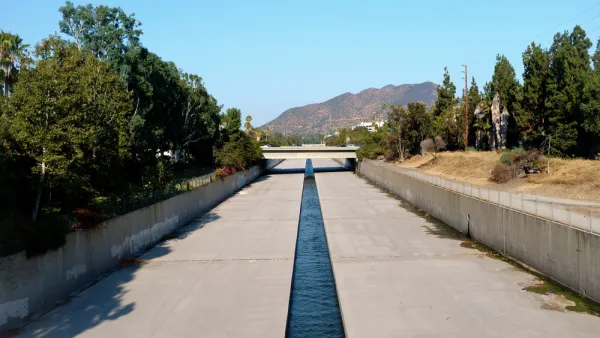
Reality Check: The Los Angeles River Can Still Flood
Sometimes it seems like it will never rain again in Los Angeles, but the river running through the city is still a significant flood risk.
Cost of River Restoration Project Rising Quickly in Los Angeles
Questions are emerging about the funding equation for an ambitious $1 billion proposal to improve 11 miles of the Los Angeles River through some of the most urban parts of the city.

Planetizen Federal Action Tracker
A weekly monitor of how Trump’s orders and actions are impacting planners and planning in America.

California plans to bury El Niño’s downpour
If the state plays its cards right, it may be able to store a billion acre-feet of El Niño’s water in aquifers.

Chicago breaks ground on $3 billion megadevelopment
The new neighborhood, titled Foundry Park, will one day host 3,700 residences.

California High-Speed Rail Authority CEO resigns after $600,000 scandal
Under Ian Choudri, the authority used taxpayer dollars to fund first class flights and trips to nightclubs.

Want to study the Missouri River? Soon, you may need unanimous approval from 10 states
Legislation would require 10 governors’ permission to study or build projects moving water outside the basin.

Desperate measures: Advocates weigh draining Lake Powell to fill Colorado River
Draining the reservoir could reduce evaporation losses by a couple hundred thousand acre-feet.

FREE Course: Walkable City 1: Why Walkability?
After describing his path towards focusing on walkability as the essence of good planning, Jeff Speck marches through his five principal reasons for making more walkable places.
Reinventing Malls: Planning Alchemy—Turning Gray Fields Into Gold
The course focuses on the opportunities and imperatives that shape reinvention of mall sites.

City of Rosemead
Rutgers University, Edward J. Bloustein School of Planning and Public Policy
One Hundred Miles
Hunter College, City University of New York (CUNY)
The Architects Foundation
University of Cincinnati Online
City of Cambridge
Montrose County
The Pocatello Development Authority