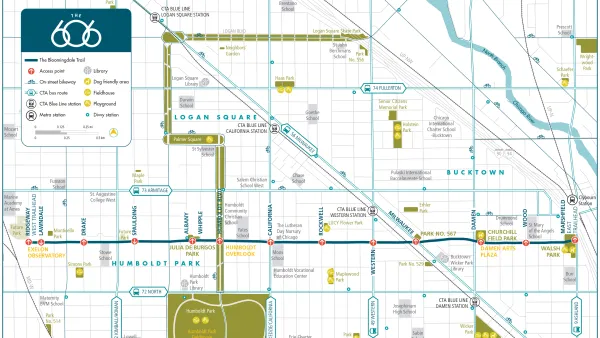
Final plans for what will become the longest elevated park in the world where unveiled this week in Chicago. The 2.7-mile rail-to-trail conversion has been branded as The 606, a nod to the zip code digits shared by the neighborhoods along its route.


"The planned 2.7-mile Bloomingdale Trail and five linked parks -- envisioned as an elevated pedestrian and bicycling corridor splashed with artwork and landscaping -- will assume a new, overarching identity Tuesday when the multi-use recreation system assumes a fresh moniker: The 606." reports Kathy Bergen. "The 606 label represents something virtually all city residents share -- the first three digits of Chicago ZIP codes, which planners hope will connote unity and links among neighborhoods."
In preparation for the project's August groundbreaking, the final plans and implementation schedule were presented at a public meeting held Tuesday. "To start, 38 bridges along the tracks will have to be repaired and rehabilitated, which will result in the some weekend road closures including Ashland, Western and Milwaukee avenues," reports Victoria Johnson. "Attendees also got sneak previews of other plans for The 606 [PDF], including a skate park, event center and stage and an observatory designed to line up with the setting sun."
"The development of a project name came about to dispel confusion surrounding the trail, which will run atop an abandoned 16-foot-high rail bed that runs above Bloomingdale Avenue, which is about 1800 [sic] north," says Bergen. "It stretches from Ashland Avenue on the east to Ridgeway Avenue on the west, linking Bucktown, Wicker Park, Logan Square and Humboldt Park."
"Lots of people thought it was in Bloomingdale, Ill., or many times people would call it the Bloomington Trail," said Beth White, director of the Trust for Public Land's Chicago office.
Read the full story: Next step for Bloomingdale Trail: Creating an identity

Meet the 606: Chicago's New Elevated Bikeway and Park
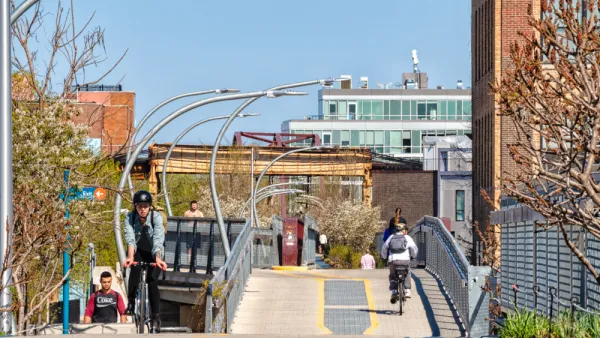
Following in the footsteps of the High Line in New York City, Chicago opened a 2.7-mile elevated park, which has already been extremely popular in its first week. Here we round up the initial reactions to The 606, as the new park is called.
Don't Call it The 606: Chicago's Popular Linear Park Gets a New Name
The Chicago Park District wants to be extra sure we're all clear on this.
More Cities Pressing Pause on Development as Gentrification, Displacement Concerns Persist
Chicago and Atlanta both approved development moratoriums in areas surrounding new urban amenities this year. Other cities could soon add to the number.

Planetizen Federal Action Tracker
A weekly monitor of how Trump’s orders and actions are impacting planners and planning in America.

Amtrak, CN end decades-long dispute with eight-year agreement
The new operating agreement establishes an updated framework for the companies to work together, including processes to resolve disputes.

Northwest rail fans eager for Sept. 30 debut of Amtrak’s Airo fleet
Get ready for that new train smell and more seats. But they won’t go faster or run more frequently on the Cascades route in Washington and Oregon.

St. Louis Metro to test if single-car trains can reduce operating costs, maintain rider satisfaction
The pilot program will run from October to spring 2027, and begin with one single-car train operating on Metrolink’s Red and Blue lines.

Pennsylvania is building data centers in abandoned mines
Housing data centers in mines provides an alternative to destroying local forests and may spare residents from data centers’ noise and air pollution.

If Corpus Christi can’t revive desalination plant project, it may owe Texas $235 million
Earlier this month, city officials declined to pursue developing the plant for the second time in a year.

FREE Course: Walkable City 1: Why Walkability?
After describing his path towards focusing on walkability as the essence of good planning, Jeff Speck marches through his five principal reasons for making more walkable places.
Reinventing Malls: Planning Alchemy—Turning Gray Fields Into Gold
The course focuses on the opportunities and imperatives that shape reinvention of mall sites.

City of Thousand Oaks
City of Wisconsin Rapids
Harvard University Graduate School of Design
The Architects Foundation
University of Cincinnati Online
The Pocatello Development Authority
The Urban Renewal Agency of the City of Pocatello