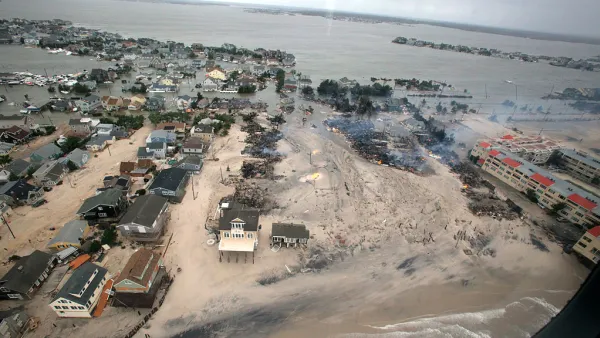
This week, Mayor Bloomberg announced the launch of NYC's comprehensive effort to assist homeowners effected by Superstorm Sandy. The NYC Build It Back program will offer avenues for homeowners to restore, rebuild, relocate, or get reimbursed.


"Since Superstorm Sandy hit, Mayor Michael Bloomberg has stressed the city would rebuild on, rather than retreat from its shores, and true to that pledge that is even the name the administration has adopted for its biggest recovery program yet, NYC Build It Back," reports Matt Chaban. "Using more than a third of the $1.77 billion Congress has so far allocated for Sandy recovery, Build It Back will help homeowners and landlords restore or rebuild their properties, or even help them relocate, should they so choose."
In announcing Build It Back, Bloomberg touted its unparalleled level of service: each applicant will be assigned a housing recovery specialist to assist their participation in the program.
"Build It Back will take on the repair and rebuilding work through city-selected contractors—which the administration is still in the process of choosing—though property owners can also work with their housing recovery specialist to qualify their own contractors," says Chaban. "For owners of properties beyond repair the city will soon have a set of pre-designed homes available that New Yorkers can choose from in replacing their properties, though as with repair work, property owners are allowed to choose their own designs. Such homes would have to be approved by the city in order for the costs to be covered."
Read the full story: City details plans to help rebuild post-Sandy
Discrimination Limits Sandy Recovery Efforts
Many New Jersey residents are waiting for state aid to help them rebuild after Hurricane Sandy. But not everyone is receiving a fair share of recovery funds. How will Governor Chris Christie respond?
New Yorkers Take Pride in Resilience, Preserve Scars from Sandy
As New York and New Jersey continue to recover from Hurricane Sandy, some residents choose to preserve the watermarks left on their homes and businesses as a way to commemorate their survival.
The Era of “When, Not If,” Compels a New Approach to Waterfront Development
On the anniversary of Hurricane Sandy, ULI offers guidance on post-disaster rebuilding and building in anticipation of future disasters in a way that helps preserve the environment, boost economic prosperity, and foster a high quality of life.

Planetizen Federal Action Tracker
A weekly monitor of how Trump’s orders and actions are impacting planners and planning in America.

California plans to bury El Niño’s downpour
If the state plays its cards right, it may be able to store a billion acre-feet of El Niño’s water in aquifers.

Desperate measures: Advocates weigh draining Lake Powell to fill Colorado River
Draining the reservoir could reduce evaporation losses by a couple hundred thousand acre-feet.

Los Angeles just elected an urban planner as its mayor
Transportation analysts are optimistic that Raman will be more aggressive in addressing transit issues than Bass.

Mamdani’s pied-à-terre tax survives legal challenge
A panel of judges found that the plaintiffs failed to demonstrate injury as a result of New York City's implementation of the tax.

Eastern Nebraska is running out of electricity
Data centers and electrification are straining eastern Nebraska’s grid, throttling economic development.

FREE Course: Walkable City 1: Why Walkability?
After describing his path towards focusing on walkability as the essence of good planning, Jeff Speck marches through his five principal reasons for making more walkable places.
Reinventing Malls: Planning Alchemy—Turning Gray Fields Into Gold
The course focuses on the opportunities and imperatives that shape reinvention of mall sites.

City of Rosemead
Rutgers University, Edward J. Bloustein School of Planning and Public Policy
One Hundred Miles
University of Michigan School for Environment and Sustainability (SEAS)
Hunter College, City University of New York (CUNY)
The Architects Foundation
City of Cambridge
Montrose County
The Pocatello Development Authority