On Places, Tom Vanderbilt surveys the landscape and politics of New York City after Hurricane Sandy, focusing on both early response and long-range planning.


For several years New York City has been exploring how to plan for climate change, but last fall Hurricane Sandy exposed the many vulnerabilities of the coastal metropolis. As Tom Vanderbilt writes: "The sea will not be forgotten."
On Places, Vanderbilt surveys the landscape and politics of both early response and long-range efforts, and he explores the persistent challenges — political, economic, cultural — that make it hard to transform a centuries-old settlement.
From the East River Esplanade (one of the few places on Manhattan where you can “get down and touch the water”) to the South Ferry Station where a bundle of construction timber caused $1 billion in damages, from the Red Hook IKEA that became a federal disaster recovery center to the ambitious plans for Cornell's Tech Campus on Roosevelt Island, Vanderbilt gets on the ground with experts facing the new reality of planning for storm surges and rising seas.
Read the full story: The City and the Sea

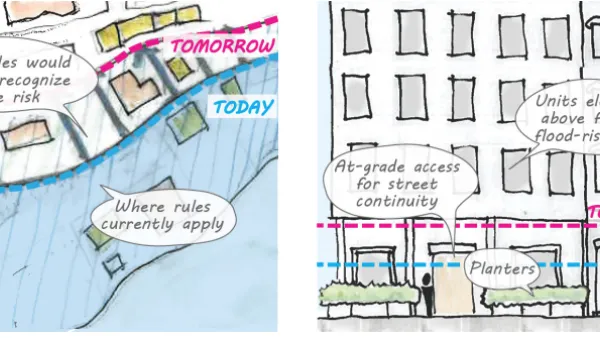
Proposed Citywide Rezoning Would Layer Resilience in New York City
With 520 miles of coastline, New York City is ready to implement the lessons of Hurricane Sandy in the zoning code for the entire city.

Why New York City's Flooding Its Own Subway Entrances
MTA reassured disoriented New Yorkers that it's flooding subway entrances on purpose, to test barriers that it hopes will guard the system against another Sandy.

Taking on Climate Change Without Wrecking Cities for the Poorest and Most Vulnerable
Rebuilding and repairing New York City after Hurricane Sandy shows how climate change can exacerbate existing equity problems and that such disasters must spur efforts to rebuild fairly, not entrench existing problems.

Planetizen Federal Action Tracker
A weekly monitor of how Trump’s orders and actions are impacting planners and planning in America.

‘Going backwards:’ Baltimore mayor, students rally against state's transit funding plan
Maryland's proposed six-year plan provides no funding for Baltimore’s BMORE bus program and reduces its road maintenance funding.

Detroit to transform waterfront with $2.2 billion investment
Developers will convert about 18 acres of unused parking lot space into civic spaces.

U.S.-Iran war may have ‘devastating’ impact on cost to warm homes
Vermont and Maine residents may see a 76% increase in the cost of warming their homes this winter.

Senate bill would ‘overhaul’ environmental permitting laws
Under the proposed act, government agencies would also not be able to suspend or rescind permits after granting them.

Exemption applications for NYC’s pied-à-terre tax see 55% success rate
The city sent nearly 40% of its initial pied-à-terre tax warnings erroneously.

FREE Course: Walkable City 1: Why Walkability?
After describing his path towards focusing on walkability as the essence of good planning, Jeff Speck marches through his five principal reasons for making more walkable places.
Reinventing Malls: Planning Alchemy—Turning Gray Fields Into Gold
The course focuses on the opportunities and imperatives that shape reinvention of mall sites.

One Hundred Miles
County of Mendocino
planning NEXT
The Architects Foundation
University of Cincinnati Online
Montrose County
Northern Illinois Transit Authority (NITA)
The Pocatello Development Authority