After a sharp decline during the recession, an industrial expansion is helping to drive job growth in many of America’s metropolitan areas. New analysis outlines the country’s best manufacturing ‘storylines’.



"We may be far from replacing the 3 million industrial jobs lost in the recession, but the economy has added over 330,000 industrial jobs since 2010, with output growing at the fastest pace since the 1990s," report Joel Kotkin and Michael Shires.
The recovery of the auto industry is supporting growth in the Great Lakes and the Mid-South and Southeast. The booming energy industry is driving rising employment in Houston, Oklahoma City, and elsewhere. And a diversity of thriving industrial sectors, from technology to petrochemicals, are driving growth in the South and West.
However, according to Kotkin and Shires, this manufacturing revival is not evident everywhere. Many of California's large metropolitan regions have “yet to participate in the nation’s industrial recovery,” the authors say. “Since 2010, manufacturing employment nationwide has grown more than 4% while in California industrial jobs have barely grown."
Read the full story: AMERICA'S NEW MANUFACTURING BOOMTOWNS

American High Speed Rail: Transportation and Jobs
The Infrastructurist's Melissa Lafsky is on Fox Business to discuss the prospect of high speed rail in America -- both in terms of transportation and jobs.
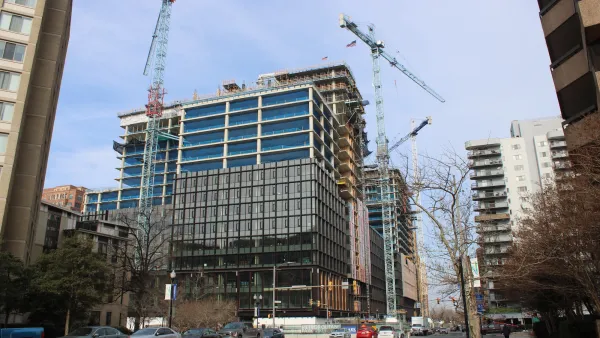
Amazon's HQ2 promised 25,000 jobs. It has created less than a third of that.
Virginia offered Amazon up to $750 million in public subsidies in exchange for creating local jobs and investment.

Data Centers Gaining Ground in Central Ohio
Massive data centers are gobbling up energy resources and tax breaks while creating few jobs in the region.

Planetizen Federal Action Tracker
A weekly monitor of how Trump’s orders and actions are impacting planners and planning in America.

California plans to bury El Niño’s downpour
If the state plays its cards right, it may be able to store a billion acre-feet of El Niño’s water in aquifers.

Chicago breaks ground on $3 billion megadevelopment
The new neighborhood, titled Foundry Park, will one day host 3,700 residences.

California High-Speed Rail Authority CEO resigns after $600,000 scandal
Under Ian Choudri, the authority used taxpayer dollars to fund first class flights and trips to nightclubs.

Want to study the Missouri River? Soon, you may need unanimous approval from 10 states
Legislation would require 10 governors’ permission to study or build projects moving water outside the basin.

Desperate measures: Advocates weigh draining Lake Powell to fill Colorado River
Draining the reservoir could reduce evaporation losses by a couple hundred thousand acre-feet.

FREE Course: Walkable City 1: Why Walkability?
After describing his path towards focusing on walkability as the essence of good planning, Jeff Speck marches through his five principal reasons for making more walkable places.
Reinventing Malls: Planning Alchemy—Turning Gray Fields Into Gold
The course focuses on the opportunities and imperatives that shape reinvention of mall sites.

City of Rosemead
Rutgers University, Edward J. Bloustein School of Planning and Public Policy
One Hundred Miles
Hunter College, City University of New York (CUNY)
The Architects Foundation
University of Cincinnati Online
City of Cambridge
Montrose County
The Pocatello Development Authority