Many planners these days are promoting higher densities, especially in urban cores. Urban scholar Joel Kotkin inexplicably takes this trend to mean that a "cult" of planners favors bone-crushing crowds that would turn US cities into slums.


"Joel Kotkin, Los Angeles-based urban theorist and persistent critic of downtown revitalization, would have you believe that advocates of smart growth—which, these days, includes not only Andres Duany, Richard Florida, and CP&DR’s own Bill Fulton but also the California Legislature and pretty much every planning director in the state—all want to turn their cities into putrid slums," writes Josh Stephens.
"There is, apparently, a 'cult of density' among urban planners these days. Specifically, Kotkin says that among 'urban core theorists perhaps no idea is more widely accepted…than the notion that higher population densities lead to more productivity and sustainable economic growth.' I hear they also sacrifice goats on subway platforms. Kotkin implies that 'higher' means 'unlimited' and that these 'theorists' believe that ever greater increments of density will result in ever higher increments of productivity."
Read the full story: Beware the 'Density Cult'

Battle Cry of the Suburban Majority
According to Joel Kotkin, the next culture war will be fought over how and where Americans choose to live. It's suburbs vs. cities, again.
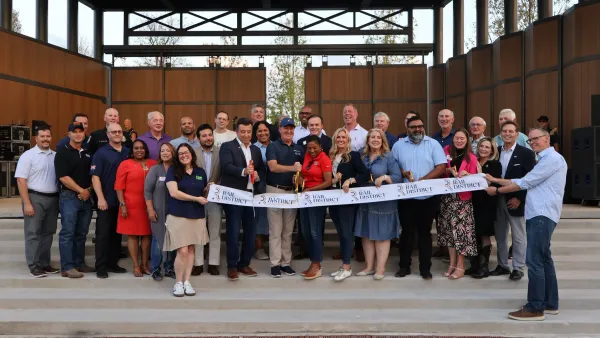
Dallas suburbs are turning their downtowns into small towns
Four Texas towns are embracing walkability and density in their downtowns.
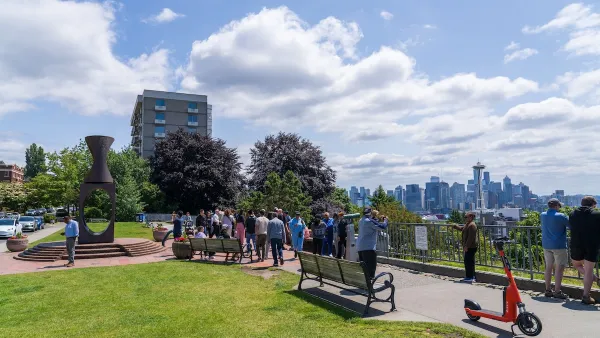
Yet again, Seattle’s density zoning update is hit with delays
The city must now examine the ‘maximum possible development’ under a future zoning scenario, rather than the ‘maximum likely development.’

Planetizen Federal Action Tracker
A weekly monitor of how Trump’s orders and actions are impacting planners and planning in America.

California plans to bury El Niño’s downpour
If the state plays its cards right, it may be able to store a billion acre-feet of El Niño’s water in aquifers.

Desperate measures: Advocates weigh draining Lake Powell to fill Colorado River
Draining the reservoir could reduce evaporation losses by a couple hundred thousand acre-feet.

Mamdani’s pied-à-terre tax survives legal challenge
A panel of judges found that the plaintiffs failed to demonstrate injury as a result of New York City's implementation of the tax.

Eastern Nebraska is running out of electricity
Data centers and electrification are straining eastern Nebraska’s grid, throttling economic development.

Seattle passes record-breaking transit services expansion
Proposition 1 will double the city’s transit tax to add 95,000 more bus trips and preserve 180,000 bus trips annually.

FREE Course: Walkable City 1: Why Walkability?
After describing his path towards focusing on walkability as the essence of good planning, Jeff Speck marches through his five principal reasons for making more walkable places.
Reinventing Malls: Planning Alchemy—Turning Gray Fields Into Gold
The course focuses on the opportunities and imperatives that shape reinvention of mall sites.

City of Rosemead
Rutgers University, Edward J. Bloustein School of Planning and Public Policy
One Hundred Miles
University of Michigan School for Environment and Sustainability (SEAS)
Hunter College, City University of New York (CUNY)
The Architects Foundation
City of Cambridge
Montrose County
The Pocatello Development Authority