Michael Kimmelman examines the race to rebuild and redefine post-revolutionary Cairo, where residents are recreating the city and civic society, and reclaiming public spaces, from the bottom-up.


"[S]ince the revolution, the pace of illegal construction has only exploded, like so much else [in Cairo]." observes Kimmelman. "Along with the spread of graffiti and of street vendors clogging the sidewalks downtown, this explosion is either a sign of post-revolutionary populist empowerment or of chaos, depending on one’s perspective. Egyptians seem to be wrestling over which every day."
"As Omar Nagati, a young Egyptian architect and planner, put it the other day: 'This was always a revolution about unjust urban conditions and about public space. The ramp is just one example. People now realize they have the right to determine what happens on their own streets, to their own neighborhoods. So there’s a battle of ownership throughout Egypt: over whose space this is, and who determines whose space it is.'”
Read the full story: Who Rules the Street in Cairo? The Residents Who Build It


Egypt's New Capital City Development Gets Chinese Backing
Plans for the development of a new, unnamed capital city just east of Cairo has received the financial backing of Chinese investors.
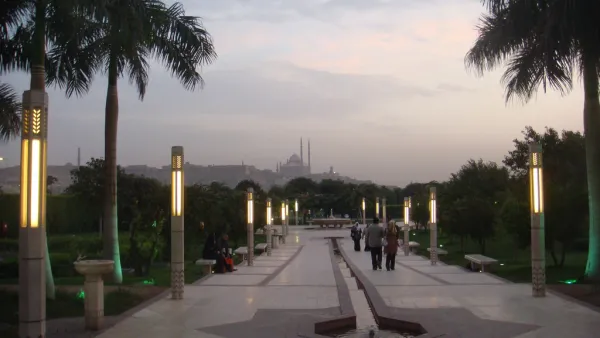
Open Spaces Are Contested Spaces in the Middle East
Parks and other public open spaces continue to be squeezed out by private development and attempts to limit political dissent throughout cities in Arab countries.
Should Egypt Build a New Capital to Replace Cairo?
Reviewing the plausibility of replacing the thousand-year-old capital of Cairo with a new, master planner, $45 billion capital city.

Planetizen Federal Action Tracker
A weekly monitor of how Trump’s orders and actions are impacting planners and planning in America.

‘Going backwards:’ Baltimore mayor, students rally against state's transit funding plan
Maryland's proposed six-year plan provides no funding for Baltimore’s BMORE bus program and reduces its road maintenance funding.

Mamdani sent nearly 6,000 pied-à-terre tax warnings to homes that didn’t qualify
A judge has ordered the administration to cancel thousands of pied-à-terre tax notices after it sent 35% of them erroneously.

Newsom vetoes high-speed rail supervision bill after agency receives condemnatory audit
The audit found the CHSRA approved almost $600,000 in unallowable travel expenses.

Nation sees first electric plane-boat hybrid take off in public demo
The Viceroy Seaglider can fly at speeds of 180mph for up to 180 miles.

One of nation’s poorest counties to receive $6 billion data center
The developers estimate the project will create 200 permanent jobs and 1,000 temporary construction jobs.

FREE Course: Walkable City 1: Why Walkability?
After describing his path towards focusing on walkability as the essence of good planning, Jeff Speck marches through his five principal reasons for making more walkable places.
Reinventing Malls: Planning Alchemy—Turning Gray Fields Into Gold
The course focuses on the opportunities and imperatives that shape reinvention of mall sites.

City of Thousand Oaks
City of Wisconsin Rapids
Harvard University Graduate School of Design
The Architects Foundation
University of Cincinnati Online
Northern Illinois Transit Authority (NITA)
The Pocatello Development Authority
The Urban Renewal Agency of the City of Pocatello