Chris Bentley describes the first piece of an ambitious plan to return portions of Minneapolis' Mississippi River coastline to a more natural state, and encourage public access and redevelopment in the process.


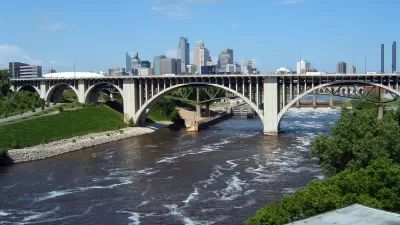
"The Minneapolis Parks Department has commenced its RiverFirst Initiative, a plan to return portions of the city’s Mississippi River frontage to a more natural state by 2016," writes Bentley. "The city hopes to position the river at the center of an ecologically focused urban development strategy that will guide growth for decades to come through strategic interventions at seven points along the waterway."
He describes the design for Scherer Park, by Berkeley-based Tom Leader Studio and Boston’s Kennedy & Violich Architecture (TLS/KVA), the first of these interventions to move forward.
“Sometimes I think of our design process as stripping away the thin industrial layer that covers the site to reveal the river as it actually is,” said KVA’s Sheila Kennedy. “So words like ‘new’ and ‘restore’ don’t really capture the idea that the hard bounded pool-like river we see today is in fact a constructed reality.”
Read the full story: River Town


Big Idea: A National Park in Downtown Minneapolis
Details of a proposal to create a national park at one of the Twin Cities' region most popular destinations: the lock and dam at the Upper St. Anthony Falls, on the Mississippi River where it flows through Minneapolis.

A Kayak Share Service Blossoms in Minneapolis
The National Park Service is bringing the sharing economy to the Mississippi River in Minnesota this month with a first of its kind kayak sharing service.
Park Project to Continue Minneapolis' Riverfront Transformation
On a site overlooking the Mississippi River's St. Anthony Falls, where Minneapolis' first sushi bar stands, officials are planning the newest addition to the city's Central Riverfront system of parks.

Planetizen Federal Action Tracker
A weekly monitor of how Trump’s orders and actions are impacting planners and planning in America.

California plans to bury El Niño’s downpour
If the state plays its cards right, it may be able to store a billion acre-feet of El Niño’s water in aquifers.

Chicago breaks ground on $3 billion megadevelopment
The new neighborhood, titled Foundry Park, will one day host 3,700 residences.

California High-Speed Rail Authority CEO resigns after $600,000 scandal
Under Ian Choudri, the authority used taxpayer dollars to fund first class flights and trips to nightclubs.

Want to study the Missouri River? Soon, you may need unanimous approval from 10 states
Legislation would require 10 governors’ permission to study or build projects moving water outside the basin.

Desperate measures: Advocates weigh draining Lake Powell to fill Colorado River
Draining the reservoir could reduce evaporation losses by a couple hundred thousand acre-feet.

FREE Course: Walkable City 1: Why Walkability?
After describing his path towards focusing on walkability as the essence of good planning, Jeff Speck marches through his five principal reasons for making more walkable places.
Reinventing Malls: Planning Alchemy—Turning Gray Fields Into Gold
The course focuses on the opportunities and imperatives that shape reinvention of mall sites.


City of Rosemead
Rutgers University, Edward J. Bloustein School of Planning and Public Policy
One Hundred Miles
Hunter College, City University of New York (CUNY)
The Architects Foundation
University of Cincinnati Online
City of Cambridge
Montrose County
The Pocatello Development Authority