Any suspected motives for the tragic events that unfolded near the finish of the Boston Marathon yesterday are conjecture as of the writing of this post. But Nicholas Thompson endeavors to explain the meaning of this celebrated event.


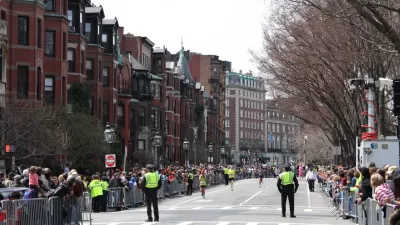
"The Boston Marathon is America’s iconic race, the oldest marathon in the country, and the most important. Eighteen people ran it in 1897; last year, thirty-five thousand did."
Thompson, who has completed the race twice, walks us through its scenic path from the start in Hopkinton, "a town so far out on the Massachusetts Turnpike that it seems like it must be farmland," up and down its punishing hills, past Fenway Park, to its conclusion "in beautiful downtown Boston. Copley Square. Newbury Street. Trinity Church."
"There’s something particularly devastating about an attack on a marathon. It’s an epic event in which men and women appear almost superhuman. The winning men run for hours at a pace even normal fit people can only hold in a sprint. But it’s also so ordinary. It’s not held in a stadium or on a track. It’s held in the same streets everyone drives on and walks down. An attack on a marathon is, in some ways, more devastating than an attack on a stadium; you’re hitting something special but also something very quotidian."
Read the full story: The Meaning of the Boston Marathon

Planetizen Federal Action Tracker
A weekly monitor of how Trump’s orders and actions are impacting planners and planning in America.

California plans to bury El Niño’s downpour
If the state plays its cards right, it may be able to store a billion acre-feet of El Niño’s water in aquifers.

Desperate measures: Advocates weigh draining Lake Powell to fill Colorado River
Draining the reservoir could reduce evaporation losses by a couple hundred thousand acre-feet.

Los Angeles just elected an urban planner as its mayor
Transportation analysts are optimistic that Raman will be more aggressive in addressing transit issues than Bass.

Mamdani’s pied-à-terre tax survives legal challenge
A panel of judges found that the plaintiffs failed to demonstrate injury as a result of New York City's implementation of the tax.

Eastern Nebraska is running out of electricity
Data centers and electrification are straining eastern Nebraska’s grid, throttling economic development.

FREE Course: Walkable City 1: Why Walkability?
After describing his path towards focusing on walkability as the essence of good planning, Jeff Speck marches through his five principal reasons for making more walkable places.
Reinventing Malls: Planning Alchemy—Turning Gray Fields Into Gold
The course focuses on the opportunities and imperatives that shape reinvention of mall sites.

City of Rosemead
Rutgers University, Edward J. Bloustein School of Planning and Public Policy
One Hundred Miles
University of Michigan School for Environment and Sustainability (SEAS)
Hunter College, City University of New York (CUNY)
The Architects Foundation
City of Cambridge
Montrose County
The Pocatello Development Authority