In what is certainly one of the most polite forms of civil disobedience we've ever encountered, a small group of guerrilla urbanists installed bike lane protectors along a Seattle street one recent night. They kindly made them easy to remove.


"An extremely polite group of anonymous guerrilla road safety activists armed with $350 worth of reflective plastic pylons turned the painted Cherry Street bike lane under I-5 into a protected bike lane Monday morning," reports
"The group—calling themselves the Reasonably Polite Seattleites—wanted to make a statement about how easy and affordable it would be for the city to use the method to make bike lanes safer all over the city. To stress how polite they are, they attached them using an adhesive pad for easy removal, according to an email sent to SDOT and Seattle Bike Blog."
"The city has removed them, but responded with an equally polite email thanking them for making the statement," notes Fucoloro. "apologizing that they had to remove them and even offering to give the pylons back."
You can read the excessively kind correspondence in Fucoloro's article.
We're reasonably sure this isn't a belated April Fool's joke.
Read the full story: Guerrilla road safety group ‘politely’ installs illegal bike lane protectors on Cherry Street
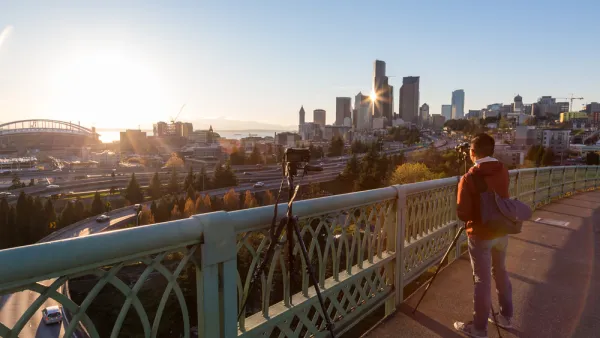
A Thorough, Mixed Review for a New Protected Bike Lane in Seattle
So many highly anticipated bike facilities finally deliver only to fall short of real game changing status. Seattle provides the latest example of the phenomenon in the wild.
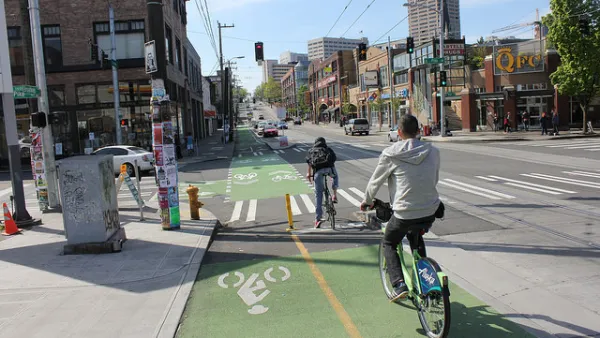
If You Build It, They Will Ride (400% More)
A more than 400 percent increase in bike ridership following the opening of a protected bike lane on Second Avenue proves that Seattleites are more inclined to ride with safe facilities.
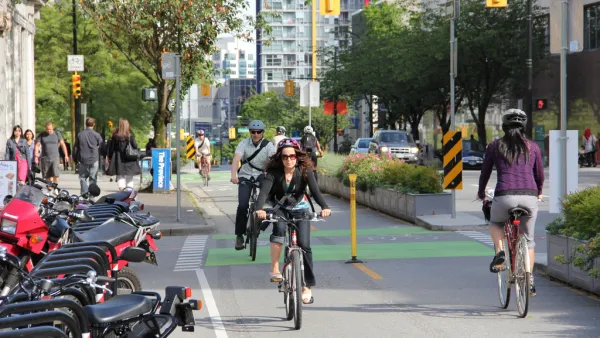
Vancouver Is 'True North' for Seattle Bike Lane Advocates
In Seattle, securing every new bike lane seems like a "tooth and nail" fight. But across a border to the north, vigorous initial opposition melted away as a connected system took shape.

Planetizen Federal Action Tracker
A weekly monitor of how Trump’s orders and actions are impacting planners and planning in America.

California plans to bury El Niño’s downpour
If the state plays its cards right, it may be able to store a billion acre-feet of El Niño’s water in aquifers.

Desperate measures: Advocates weigh draining Lake Powell to fill Colorado River
Draining the reservoir could reduce evaporation losses by a couple hundred thousand acre-feet.

Mamdani’s pied-à-terre tax survives legal challenge
A panel of judges found that the plaintiffs failed to demonstrate injury as a result of New York City's implementation of the tax.

Eastern Nebraska is running out of electricity
Data centers and electrification are straining eastern Nebraska’s grid, throttling economic development.

Seattle passes record-breaking transit services expansion
Proposition 1 will double the city’s transit tax to add 95,000 more bus trips and preserve 180,000 bus trips annually.

FREE Course: Walkable City 1: Why Walkability?
After describing his path towards focusing on walkability as the essence of good planning, Jeff Speck marches through his five principal reasons for making more walkable places.
Reinventing Malls: Planning Alchemy—Turning Gray Fields Into Gold
The course focuses on the opportunities and imperatives that shape reinvention of mall sites.

City of Rosemead
Rutgers University, Edward J. Bloustein School of Planning and Public Policy
One Hundred Miles
University of Michigan School for Environment and Sustainability (SEAS)
Hunter College, City University of New York (CUNY)
The Architects Foundation
City of Cambridge
Montrose County
The Pocatello Development Authority