With Galveston, Texas as their model, city leaders in the Jersey Shore town of Highlands are considering whether to raise the entire downtown as a bulwark against storm damage and rising seas.


Peter Applebome looks at the long shot solution that officials in Highlands, New Jersey view as the best option to save their town: "...Highlands officials are increasingly focused on one bit of radical surgery from the past and the idea that their best option might be to import perhaps 3.5 million cubic yards of dredged material and elevate the entire downtown, rather than face an eternity of flooded streets and regular disruption."
They're looking to history as the model for a project that could cost upwards of $25 million. After more than 6,000 people perished in the great hurricane of 1900, Galveston, Texas was raised as much as 17 feet.
“'Right now, there’s no endgame,' said Frank Nolan, mayor of this community of 5,000 residents where 1,250 of the 1,500 homes and virtually all the businesses were destroyed or badly damaged by the hurricane. 'We’re still going to flood. We’re still going to have businesses that are not going to make it.'"
“We believe the only way to fix this town long-term is to raise the town.”
Read the full story: Lifting a Town to Escape the Next Storm
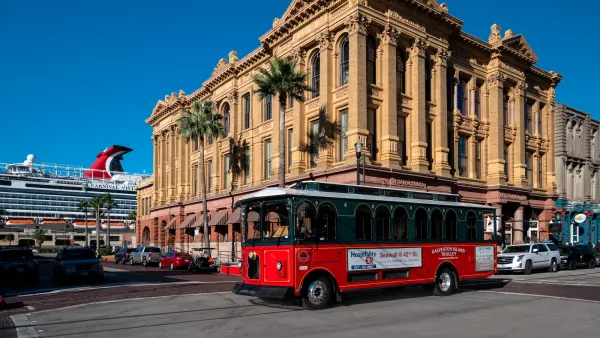
A Historic Texas Beach Town Faces Existential Growth Questions
Galveston, Texas is growing — and so are questions about its land use strategy.

3D Modeling Aids in Predicting Hurricane Damage
Texas researchers are testing the tool in Galveston, where Hurricane Ike caused billions in damage in 2008.
East River Floodgates Rising in NYC
A tour of new infrastructure designed to protect the city’s East Side from catastrophic flooding.

Planetizen Federal Action Tracker
A weekly monitor of how Trump’s orders and actions are impacting planners and planning in America.

California plans to bury El Niño’s downpour
If the state plays its cards right, it may be able to store a billion acre-feet of El Niño’s water in aquifers.

Desperate measures: Advocates weigh draining Lake Powell to fill Colorado River
Draining the reservoir could reduce evaporation losses by a couple hundred thousand acre-feet.

Mamdani’s pied-à-terre tax survives legal challenge
A panel of judges found that the plaintiffs failed to demonstrate injury as a result of New York City's implementation of the tax.

Eastern Nebraska is running out of electricity
Data centers and electrification are straining eastern Nebraska’s grid, throttling economic development.

Seattle passes record-breaking transit services expansion
Proposition 1 will double the city’s transit tax to add 95,000 more bus trips and preserve 180,000 bus trips annually.

FREE Course: Walkable City 1: Why Walkability?
After describing his path towards focusing on walkability as the essence of good planning, Jeff Speck marches through his five principal reasons for making more walkable places.
Reinventing Malls: Planning Alchemy—Turning Gray Fields Into Gold
The course focuses on the opportunities and imperatives that shape reinvention of mall sites.

City of Rosemead
Rutgers University, Edward J. Bloustein School of Planning and Public Policy
One Hundred Miles
University of Michigan School for Environment and Sustainability (SEAS)
Hunter College, City University of New York (CUNY)
The Architects Foundation
City of Cambridge
Montrose County
The Pocatello Development Authority