In this holiday essay, spelunker John Watts delivers an everyman’s take on Chesterton’s oft-noted adage: Places don’t become loved because they are great; they become great because they are loved. Does your town invite “word-of-mouth walking?”


"I am always profoundly moved and impacted by those special strangers I’ve had the privilege to meet in the course of my travels who go out of their way to not only answer basic informational or directional questions with great kindness, but then take that extra step and leap of faith to evangelize and bring to life their town or city. They are promoters and boosters extraordinaire that combine warm interpersonal skills with a great contagious affection and pride for their local digs."
"So please indulge me as I devote some brief paragraphs ahead to acknowledge some very notable examples of such civic paragons of philanthropy from the past several years. These people stand out to me like lighthouses even if the names are missing. Therefore, this is decidedly not a travel log or a restaurant or B&B review—this is a prosaic tribute to some amazing people who dazzled me on far from home and remain in my memory long after the specific questions I asked have been forgotten."
John Watts is not a city planner, but instead tells some tales from his explorer/observer point of view about his experiences in Chicago, IL, Spokane, WA, and Baker City, OR. In his experiences, "kindred soulds of the road" pulled him deeper into the urbanism, and created some meaningful "word-of-mouth walking."
Read the full story: To Those Proud and Exuberant Promoters of Town, City and State: I say thank you!
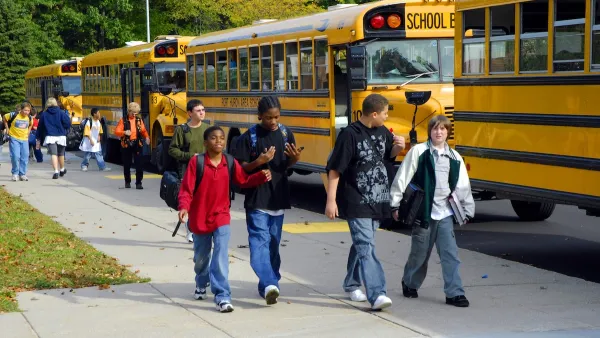
Learning loss and urban schools, part 2
Did test scores in progressive cities drop more post-COVID than test scores in moderate ones?
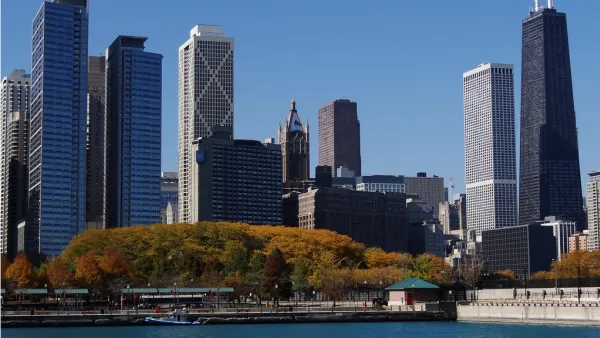
New Energy Rating System for Chicago Buildings
The city will evaluate all buildings over 50,000 square feet and make the energy performance ratings and information easily accessible.

Is This Chicago Indoor Vertical Farm the Future of Agriculture?
A new indoor vertical farming venture in Chicago seeks to change agricultural production by harnessing technology.

Planetizen Federal Action Tracker
A weekly monitor of how Trump’s orders and actions are impacting planners and planning in America.

California plans to bury El Niño’s downpour
If the state plays its cards right, it may be able to store a billion acre-feet of El Niño’s water in aquifers.

Desperate measures: Advocates weigh draining Lake Powell to fill Colorado River
Draining the reservoir could reduce evaporation losses by a couple hundred thousand acre-feet.

Mamdani’s pied-à-terre tax survives legal challenge
A panel of judges found that the plaintiffs failed to demonstrate injury as a result of New York City's implementation of the tax.

Eastern Nebraska is running out of electricity
Data centers and electrification are straining eastern Nebraska’s grid, throttling economic development.

Seattle passes record-breaking transit services expansion
Proposition 1 will double the city’s transit tax to add 95,000 more bus trips and preserve 180,000 bus trips annually.

FREE Course: Walkable City 1: Why Walkability?
After describing his path towards focusing on walkability as the essence of good planning, Jeff Speck marches through his five principal reasons for making more walkable places.
Reinventing Malls: Planning Alchemy—Turning Gray Fields Into Gold
The course focuses on the opportunities and imperatives that shape reinvention of mall sites.

City of Rosemead
Rutgers University, Edward J. Bloustein School of Planning and Public Policy
One Hundred Miles
University of Michigan School for Environment and Sustainability (SEAS)
Hunter College, City University of New York (CUNY)
The Architects Foundation
City of Cambridge
Montrose County
The Pocatello Development Authority