In the wake of what is becoming an all too common occurrence in the U.S., Richard Florida examines whether gun violence, and especially mass killings of the kind that took place last week in Newtown, is an urban or suburban/rural plague.


"All too often gun violence in America is posed as an urban problem," says Florida. And although cities do, in fact, have the highest rates of murders by gun, research conducted by Florida with Atlantic Cities' fellow Sara Johnson reveals that, "the wide majority of mass killings and especially mass school killings have occurred not in the urban centers of large cities, but in the small towns, burgs and villages of our suburban and rural areas."
Digging deeper into the grim topic by looking at CDC data on gun murders, gun suicides and overall gun deaths, Florida found "no statistical relationship at all between gun-related murders and the size and density of metros, and a negative relationship between metro size and density and overall gun deaths. [He] also found the overall rate of gun death to be positively associated with the share of people who drive alone to work, which may reflect the social isolation that goes along with suburban sprawl."
He concludes that, "[w]hile some in the media tend to portray poor urban areas as breeding crime and violence, it's the quiet suburbs and rural areas which appear to be more likely breeding grounds for mass killers and mass killings." Perhaps such information will lead to more effective policies to help put an end to an appalling trend.
Read the full story: Gun Violence Is an Everywhere Issue
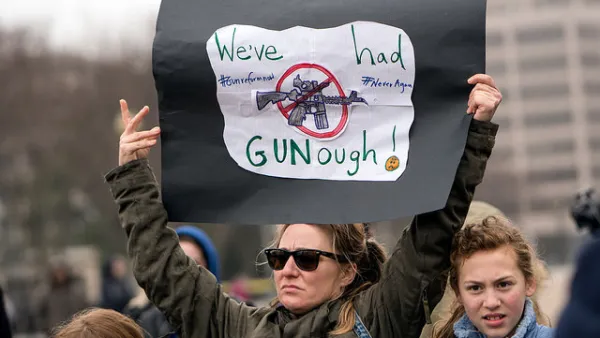
Keeping Our Children Safe After the Parkland High School Shooting
In the aftermath of the Marjory Stoneman Douglas High School mass shooting in Florida, the debate has been wide-ranging, from gun safety to arming teachers. All agree students must be safe, so why not look at architecture? The NRA has some tips.
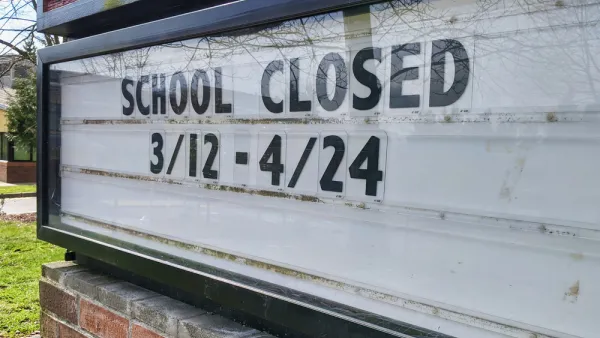
An American Lockdown
Words matter. Road safety advocates know that "crashes are not accidents." Similarly, calling coronavirus restrictions "lockdowns," fails to distinguish the severity among public health orders. On January 6, America experienced a true lockdown.
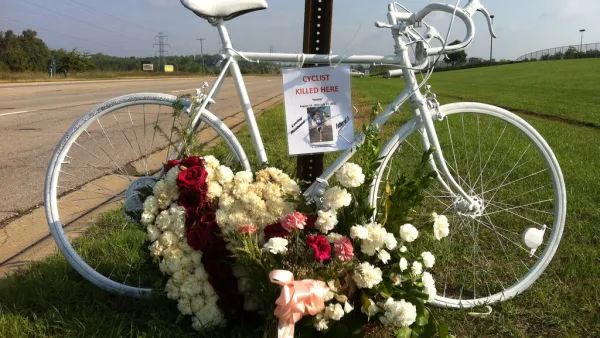
Op-Ed: Street Safety Is a Matter of Race
What do traffic safety and gun violence have in common? A lot, as it turns out. In both cases, hard-hit neighborhoods tend to have suffered from historical disinvestment along racial lines.

Planetizen Federal Action Tracker
A weekly monitor of how Trump’s orders and actions are impacting planners and planning in America.

Eastern Nebraska is running out of electricity
Data centers and electrification are straining eastern Nebraska’s grid, throttling economic development.

Study reveals best places in the U.S. for cycling, walking
New research from Streetlight Data examines bicycle and pedestrian miles per capita in the 100 largest U.S. cities by population.

Federal government nominates new FTA administrator
Mark Aesch is currently the founder and CEO of a transportation management consulting firm.

Developers reveal $10 billion stadium plan as ‘Hail Mary’ to keep Bears in Chicago
The plan would also boast a public park, high- and mid-rise buildings and a youth sports complex.

As Texas embraces carbon storage, a Black community questions the risks
Texas now issues permits for companies to store carbon dioxide underground. East Texas residents fear safety risks, and skeptics doubt the climate benefits.

FREE Course: Walkable City 1: Why Walkability?
After describing his path towards focusing on walkability as the essence of good planning, Jeff Speck marches through his five principal reasons for making more walkable places.
Reinventing Malls: Planning Alchemy—Turning Gray Fields Into Gold
The course focuses on the opportunities and imperatives that shape reinvention of mall sites.

City of Rosemead
Rutgers University, Edward J. Bloustein School of Planning and Public Policy
One Hundred Miles
University of Michigan School for Environment and Sustainability (SEAS)
Hunter College, City University of New York (CUNY)
The Architects Foundation
City of Cambridge
The Pocatello Development Authority
The Urban Renewal Agency of the City of Pocatello