A tower proposed by William Gottlieb Real Estate for a site adjacent to the High Line, being designed by architect Jeanne Gang, "promises to be one of the most talked-about buildings in New York," if it can get planning approval.


Lee Bey describes the elements that make Gang's Solar Carve Tower, which would be the first New York project for the Chicago-based architect and incorporates the sun's movement in its design, the talk of the town.
"The firm's
analyses showed the sliced tower would allow 200 more hours of sunlight
per year to fall on the High Line," says Bey. "But because of its unusual shape,
which aims to bring light and air to the raised park instead of just the
streets below, the architect and developer are seeking a zoning
variance from the city's Board of Standards and Appeals."
"'You want
to bring light and air to the street, but zoning hasn't caught up,' to
treating the High Line as such, Gang says. 'If we were to build what we
were allowed to build, we'd be essentially running [the High Line] into a
tunnel,' similar to how the Standard Hotel currently straddles the
park."
"Gang says she hopes to have the variance granted by May. 'We're
hoping they will recognize how important this is,' she says. The project
is tentatively scheduled to be completed by late 2015."
Read the full story: Gang's Solar Carve Tower Will Keep High Line in the Spotlight
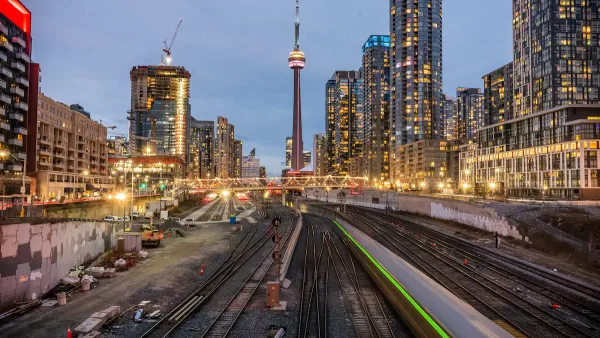
Toronto to Explore Potential High Line-Style Park
City staff will study options for transforming a defunct rail corridor into a linear park.

High Line-Moynihan Connector Opens in New York City
Two footbridges now link the High Line park to the most recent expansion of the Penn Station complex, the Moynihan Train Hall.

How Albany Can Reclaim Its Waterfront From a Bad Highway
Finding full-scale highway removal nearly impossible, advocates in the New York state capital turn to creative workarounds to reconnect the city to the Hudson River.

Planetizen Federal Action Tracker
A weekly monitor of how Trump’s orders and actions are impacting planners and planning in America.

California plans to bury El Niño’s downpour
If the state plays its cards right, it may be able to store a billion acre-feet of El Niño’s water in aquifers.

Desperate measures: Advocates weigh draining Lake Powell to fill Colorado River
Draining the reservoir could reduce evaporation losses by a couple hundred thousand acre-feet.

Mamdani’s pied-à-terre tax survives legal challenge
A panel of judges found that the plaintiffs failed to demonstrate injury as a result of New York City's implementation of the tax.

Eastern Nebraska is running out of electricity
Data centers and electrification are straining eastern Nebraska’s grid, throttling economic development.

Seattle passes record-breaking transit services expansion
Proposition 1 will double the city’s transit tax to add 95,000 more bus trips and preserve 180,000 bus trips annually.

FREE Course: Walkable City 1: Why Walkability?
After describing his path towards focusing on walkability as the essence of good planning, Jeff Speck marches through his five principal reasons for making more walkable places.
Reinventing Malls: Planning Alchemy—Turning Gray Fields Into Gold
The course focuses on the opportunities and imperatives that shape reinvention of mall sites.

City of Rosemead
Rutgers University, Edward J. Bloustein School of Planning and Public Policy
One Hundred Miles
University of Michigan School for Environment and Sustainability (SEAS)
Hunter College, City University of New York (CUNY)
The Architects Foundation
City of Cambridge
Montrose County
The Pocatello Development Authority