Across the strait from Singapore, Iskandar Malaysia is being planned as the world’s next eco mega-city. Its architects and developers hope it will offer an alternative to Asia's polluted cities and a glimpse of the future of urban living.


The plans for Iskandar Malaysia center on environmentally friendly technologies including renewable energy sources, waste recycling, and green spaces for social integration. The Malaysian government expects the mega-city to be the start of "an end to the pollution that afflicts so many of Asia's cities" and "a showcase to be copied on a bigger scale across the region," reports Fiona Harvey.
As the number of urban dwellers in the world surpasses that of rural-dwellers, Iskandar Malaysia is designed to combat the social and environmental impacts of future population growth in southeast Asia. It is expected to house 3 million people by 2025 and could be "a model to countries needing to accommodate the social and economic needs of fast-rising populations and environmental challenges," said Ellis Rubinstein, president of the New York Academy of Sciences.
Currently, $30 billion has been promised for the building of the city, which will include a Legoland and the remote campuses of several UK universities. The track record for previously announced eco-cities has been less than perfect. Good luck Iskandar!
Read the full story: Iskandar Malaysia - the green mega-city rising above Singapore
New Eco-City Planned in China
A new 350,000-person eco-city is being planned in China, this time with cooperation from Singapore. Planners are hopeful that it can serve as a sustainable model for development in countries with high population growth.

The city is the health system
Your healthcare system treats you after you get sick. Your city decides whether your health declines at all. Singapore is proving that planning is preventive medicine.
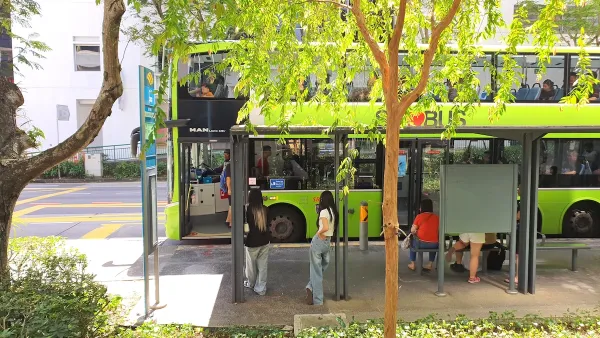
Eating, littering on Singapore buses now a fineable offense
Passengers who put other riders in danger may be charged thousands of Singapore dollars.

Planetizen Federal Action Tracker
A weekly monitor of how Trump’s orders and actions are impacting planners and planning in America.

California plans to bury El Niño’s downpour
If the state plays its cards right, it may be able to store a billion acre-feet of El Niño’s water in aquifers.

Desperate measures: Advocates weigh draining Lake Powell to fill Colorado River
Draining the reservoir could reduce evaporation losses by a couple hundred thousand acre-feet.

In Texas, data centers are swallowing promised parkland
Residents who moved to Taylor, Texas for a rural community now have to contend with three data centers in their backyard.

How a Chicago-sized wind farm beat the odds and powered on
The project spanned five presidential administrations and a standoff with a U.S. military base.

MTA gives itself 30 days to transform pit into basketball court
The site has been under construction since 2022; the city originally estimated it would finish the court in 2024.

FREE Course: Walkable City 1: Why Walkability?
After describing his path towards focusing on walkability as the essence of good planning, Jeff Speck marches through his five principal reasons for making more walkable places.
Reinventing Malls: Planning Alchemy—Turning Gray Fields Into Gold
The course focuses on the opportunities and imperatives that shape reinvention of mall sites.

City of Rosemead
Rutgers University, Edward J. Bloustein School of Planning and Public Policy
One Hundred Miles
Hunter College, City University of New York (CUNY)
The Architects Foundation
University of Cincinnati Online
City of Cambridge
Montrose County
The Pocatello Development Authority