I can't remember the last time I left the house and gave a moment's though to whether I'd be warm enough, or whether I needed to bring an umbrella. Meanwhile, half the East Coast is underwater right now.


I can't remember the last time I left the house and gave a moment's though to whether I'd be warm enough, or whether I needed to bring an umbrella. Meanwhile, half the East Coast is underwater right now. Friends on Facebook have posted status updates about "hurricane envy," and the tales of destruction, disruption, heroism, and all-night parties gush in like tidal surges.
Superstorm Sandy will give urban planners pause for many reasons, not the least of which is how to build in low-lying areas in the age of climate change. But seawalls and shoreline setbacks don't interest me nearly as much as the little things:
- Extension cords and power strips with signs inviting passers-by to charge their phones.
- Fireside gatherings.
- Huddled walks through dark, quiet streets.
- Searches for the old and infirm, and efforts to shuttle them to higher ground, in what has become America's corner of the post-apocalypse.
- The elation of making it out alive, and of beholding so much of the city that still stands.
Two days ago a friend of mine walked three miles, over the Brooklyn Bridge, from one borough to another to seek safe haven. How many multitudes must he have passed? How much like Whitman must he have felt?
Planners define cities by their form: the curve of their streets and the massing of their buildings. But we all know that the character of a city -- its values, culture, and, yes, personality -- however ineffable it may seem, matters as much as does the built environment. Usually the two are complementary, of course. Certain places breed certain people.
But places do not breed people so much as they do events.
Most people move to places because of things they like about it. Most planners want to plan places that they think people will like. No one moves to a place with a worst-case scenario in mind. But sometimes the worst-case scenarios are what define cities -- and, paradoxically, perversely, sometimes for the better.
You don't have to be a psychologist to know that hate is a stronger emotion than love, and that fear is stronger than elation. You don't have to have fought in a war to know that trauma can bind people. As New York has demonstrated this week -- as it has so many other times -- the true character of a city lies in shared hardship.
I wish we shared more things, these days. I wish we shared more cups of sugar and bottles of wine. I wish we shared more jokes and stories. I wish we still had mix tapes. But America is usually too busy for those things. Even the greatest American cities are too frantic, to be sure.
I conceive of shared hardship from a position of envy, a position which I know I ought not have. And yet, Los Angeles, my hometown, exists to avoid hardship. We gripe when the temperature drops below 60. All of the real hardships--inconveniences, really--are our own making, and they are not not the kind that ennobles civic character.
Nothing pains Angelenos as much as traffic does. But we are not in traffic. We are not fighting, together, against a common current. We are traffic. We are all each other's enemies. There is no beast to slay. And traffic, much as we might like to commiserate, drives us apart from each other by definition. We are at our most miserable and our most alone at the very same time.
As for the obvious: earthquakes are a special kind of disaster. Nothing in this world strikes with so little announcement. The earthquake proclaims itself, without time for us the jolted to summon our inner tenderness. The worst of them entail endless seconds of terror followed by an indefinite period of being pissed off, jumpy, and anxious. Holding each other closely does no good; it just heightens the chance that you'll be crushed by the same chunk of ceiling. Our signature weather event is the Santa Ana winds, which yield nothing but sleeplessness, irritability, and dry skin.
Los Angeles wears its indifference like a Prada label. I'm a pretty friendly guy, and I don't know a single neighbor's name. In Los Angeles, we complain a lot. But we do not suffer.
Consider so many other places and how they cope. In the Twin Cities, you can't help but be "Minnesota nice" when you know that six months of frigidity and five-foot snowdrifts are in the offing. The Cajun spirit was forged in New Orleans in part by decades of hurricanes, of which Katrina is only the latest example. The chill of Denver pushes 20-somethings into bars and brewpubs; same for the rain in Seattle and Portland. Civic pride in San Francisco and Chicago both arise in part from those cities' ashes. Across the Great Plains, tornadoes, hail, and even a good thunderstorm will do.
And there's always New York: blackouts, blizzards, hurricanes, and other acts to which no God would ever lay claim.
In each of these cases, disaster and discomfort have raised civic spirits. They inspire little gestures, like shoveling a neighbor's sidewalk or letting her borrow your cell phone. They create heroes. They wash away dreams and force residents to rebuild. People to congregate on streetcorners, forget about their phones and computers, and share some stories. If the corner bar or cafe stays open, that's where the neighborhood rides out the storm. Sometimes, when the lights go out, they lead to even more residents.
One Facebook friend wrote, with the raw eloquence that can only come from intense experience: "People laying prostrate next to outlets at banks and restaurants; putting makeup on in public restrooms; cheering when linksys is a wifi option; trucking a suitcase around with you everywhere; drinking at all times of the day; endless delays and thus more drinking New York City literally has become one giant airport."
Meanwhile, people out here--no matter how strong our feelings of sympathy and support may be--are selling scripts and doing Pilates.
Not I nor anybody else would wish Superstorm Sandy on anyone. And yet, there's that envy. The envy derives from our fascination with the power of nature, to be sure. But it is, I think, also an envy of human contact. It's an envy of how we feel, about ourselves and about each other, when we collectively face something more awesome than we are. It's an envy that comes from the conviction that something good must come of this.
As the post-Sandy days wear on, I dearly hope that spiritedness does not give way to frustration, with so much to rebuild and so much drying-out left. I don't know what the threshold is for despair or when frayed nerves will overwhelm the cooperative instinct.
In New York next week, I hope we don't find out. In Los Angeles, as in so many other places forged in the name of comfort, I know we will never find out. In a perfect world, one that looks superficially like Los Angeles and not at all like Atlantic City, everyone would always work to make life better. The brawn needed to sump basements and haul debris would go towards noble buildings and flat sidewalks. The momentary cooperation would be spread into daily nods and smiles.
As the people of the East Coast undergo these trials involuntarily, may the rest of us, who have the luxury of light, power, and mobility, show our mettle in ways of our own choosing so that no one and no place needs to be the object of envy.

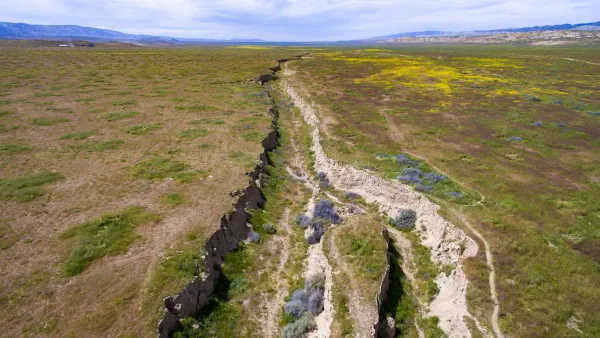
San Andreas fault at highest stress level in a millennium
A new study shows that the West Coast's major fault system is in 'a critically loaded state.'
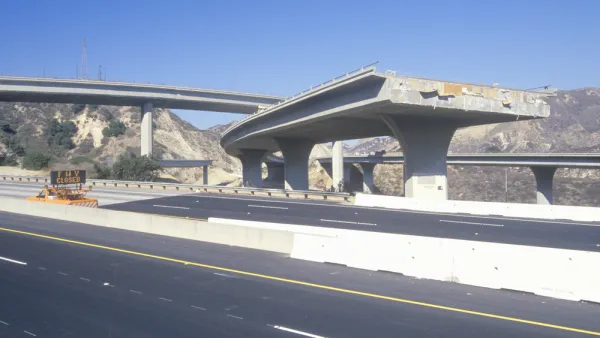
Los Angeles County the Riskiest Place in the U.S., FEMA Says
The new National Risk Index calculates the brutal equations of natural disasters.
Five Years of 100 Resilient Cities
It's been five years since the Rockefeller Foundation launched the 100 Resilient Cities initiative. A new analysis by the Urban Institute evaluates the accomplishments of 100 Resilient Cities so far.

Planetizen Federal Action Tracker
A weekly monitor of how Trump’s orders and actions are impacting planners and planning in America.

Amtrak, CN end decades-long dispute with eight-year agreement
The new operating agreement establishes an updated framework for the companies to work together, including processes to resolve disputes.

Northwest rail fans eager for Sept. 30 debut of Amtrak’s Airo fleet
Get ready for that new train smell and more seats. But they won’t go faster or run more frequently on the Cascades route in Washington and Oregon.

LAX SkyLink opening delayed again, contractor won’t commit to new deadline
The project was supposed to open its doors to the public in 2023.

Caltrain may slash over one-third of its stations
If Bay Area voters reject two transit tax measures, Caltrain, BART and AC Transit will see steep service cuts.

A 'dangerous' precedent: North Carolina successfully pressures communities into voting for toll roads
Two mayors resigned from the Charlotte Regional Transportation Planning Organization after it voted in favor of the toll roads.

FREE Course: Walkable City 1: Why Walkability?
After describing his path towards focusing on walkability as the essence of good planning, Jeff Speck marches through his five principal reasons for making more walkable places.
Reinventing Malls: Planning Alchemy—Turning Gray Fields Into Gold
The course focuses on the opportunities and imperatives that shape reinvention of mall sites.

City of Thousand Oaks
City of Wisconsin Rapids
Harvard University Graduate School of Design
The Architects Foundation
University of Cincinnati Online
The Pocatello Development Authority
The Urban Renewal Agency of the City of Pocatello

