A 22 acre parcel of federal buildings located within spitting distance of the National Mall could transform the heart of the Nation's Capital, as the GSA seeks ideas from developers on how to use its many current and soon-to-be abandoned buildings.


Called Federal Triangle South, the site located only a block from some of D.C.'s premier institutions could accommodate up to 6.1 million square feet of development under current zoning. If planners and city leaders have their way, the site could one day be home to a mix of uses sorely missing from the neighborhood surrounding Washington D.C.'s central attractions.
"The GSA announced at the end of September
that it plans to seek ideas from the private sector for what to do with
the drab cluster of buildings, opening the door to what could be the
largest redevelopment of federal land in downtown Washington since the
Ronald Reagan Building and International Trade Center was built 15 years
ago," reports Jonathan O'Connell. "The stakes for the government and the city are high."
"[The National Capital Planning Commission's Marcel C. Acosta] was one of a number of planning experts who strongly
suggested that the GSA follow recent successes elsewhere in the District
- such as Penn Quarter and Columbia Heights - by incorporating a mix of
uses on the site. And that means housing."
"Condos may never
be added atop the Smithsonian institutions that line the National Mall,
but new high-end housing is creeping closer and closer," says O'Connell.
Read the full story: Neighborhood living near the National Mall?

An American Lockdown
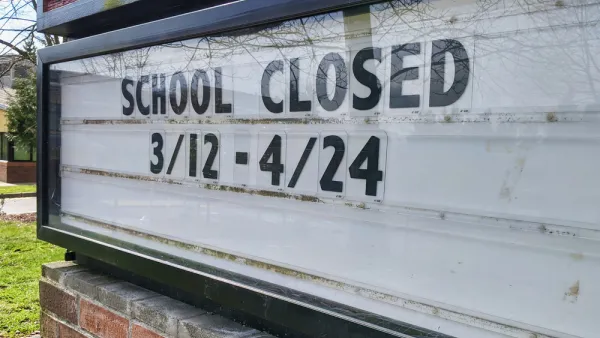
Words matter. Road safety advocates know that "crashes are not accidents." Similarly, calling coronavirus restrictions "lockdowns," fails to distinguish the severity among public health orders. On January 6, America experienced a true lockdown.
The National Museum of African American History and Culture Takes Its Rightful Place
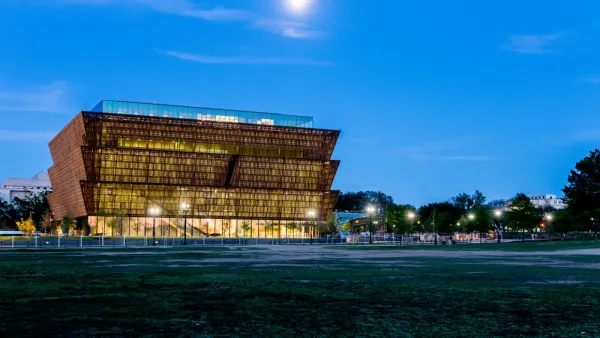
The reviews are pouring in for the new National Museum of African American History and Culture, set to open on September 24, 2016.
What is the Role of the National Mall?
The cancellation of the Hirshhorn Museum's bubble project has Dan Malouff pondering the role of the National Mall. Should it be an urban room whose buildings define its open space, or the setting for risk-taking architecture?

Planetizen Federal Action Tracker
A weekly monitor of how Trump’s orders and actions are impacting planners and planning in America.

California plans to bury El Niño’s downpour
If the state plays its cards right, it may be able to store a billion acre-feet of El Niño’s water in aquifers.

Desperate measures: Advocates weigh draining Lake Powell to fill Colorado River
Draining the reservoir could reduce evaporation losses by a couple hundred thousand acre-feet.

In Texas, data centers are swallowing promised parkland
Residents who moved to Taylor, Texas for a rural community now have to contend with three data centers in their backyard.

How a Chicago-sized wind farm beat the odds and powered on
The project spanned five presidential administrations and a standoff with a U.S. military base.

MTA gives itself 30 days to transform pit into basketball court
The site has been under construction since 2022; the city originally estimated it would finish the court in 2024.

FREE Course: Walkable City 1: Why Walkability?
After describing his path towards focusing on walkability as the essence of good planning, Jeff Speck marches through his five principal reasons for making more walkable places.
Reinventing Malls: Planning Alchemy—Turning Gray Fields Into Gold
The course focuses on the opportunities and imperatives that shape reinvention of mall sites.

City of Rosemead
Rutgers University, Edward J. Bloustein School of Planning and Public Policy
One Hundred Miles
Hunter College, City University of New York (CUNY)
The Architects Foundation
University of Cincinnati Online
City of Cambridge
Montrose County
The Pocatello Development Authority