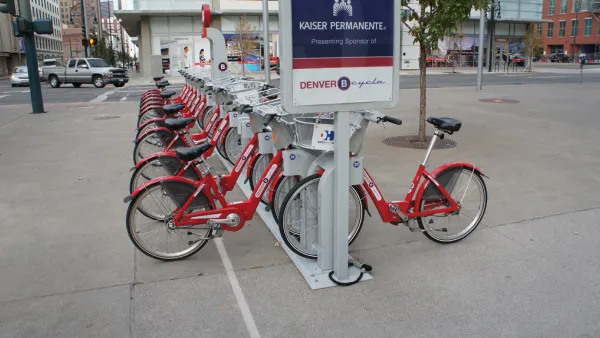
As Denver B-Cycle, the country's first large-scale municipal bike-sharing program, seeks to expand with 27 new stations, one city councilman is objecting to the plans with concerns that the system is skirting poor and minority neighborhoods.


Although the expansion plans that were set to go before the Denver City Council this week are thought to have widespread support, as Jeremy P. Meyer reports, "Councilman Paul Lopez, who represents a mostly Latino district in southwest Denver, has been the lone vote against the expansion, saying the 2-year-old bike-sharing program should be for everyone."
"This shouldn't be just for people who can afford it," Lopez said.
"It's truly sad that just one (of the stations) is in west Denver.
That truly says something."
"Program officials said they must
put stations where they can get the most ridership," notes Meyer, "and in some cases
cultural barriers prevent some people from hopping onto the B-Cycle's
red-framed bikes with the big white baskets."
"Lopez said the stations are needed in
areas that are the least healthy in the city. His district has a high
rate of obesity and diabetes, and he said residents should be given
every type of encouragement to exercise."
"If it is truly about
behavioral change, make it available where it is really needed or where
it will have impact," he said. "Is this truly, truly about the issues
and behavioral change or is this just for looks?"
Read the full story: Denver B-Cycle program faces criticism that it skirts poor, minorities

Big Bike and Scooter Rental Shakeup Coming to Denver
Publically-owned bikeshare company B-Cycle will be scrapped and eventually be replaced, and the city is also planning to overhaul it's pilot dockless bike and scooter rental program.
America's Best Bike Cities
With gas prices at an all time high, bike riding has never looked better. Shermans Travel identifies the top cities to bike through, noting a bounty of amenities to save on costs for the urban biker.
More U.S. Cities Launching Bike Sharing Programs
More American cities are following successful European cities' leads and launching their own bike sharing systems.

Planetizen Federal Action Tracker
A weekly monitor of how Trump’s orders and actions are impacting planners and planning in America.

Amtrak, CN end decades-long dispute with eight-year agreement
The new operating agreement establishes an updated framework for the companies to work together, including processes to resolve disputes.

Judges permit Denver to divert 77,000 acre feet from the Colorado River for reservoir expansion
Overuse and climate change have caused the Colorado River’s water levels to plummet.

NYC DOT wants faster, more permanent street upgrades
The city is examining ways to build more concrete infrastructure without getting entangled in 'decades-long' projects.

'Something we’ve never seen before:' rising utility rates could strain city finances nationwide
Data centers, climate change and other factors have caused utility rates in the United States to increase by 38% since 2020.

Trump to overrule local leaders, lease millions of acres of America’s Pacific Island territories’ seafloors to mining companies
International law says that the Indigenous people of America’s territories have a right to prior and informed consent regarding projects that impact their countries.

FREE Course: Walkable City 1: Why Walkability?
After describing his path towards focusing on walkability as the essence of good planning, Jeff Speck marches through his five principal reasons for making more walkable places.
Reinventing Malls: Planning Alchemy—Turning Gray Fields Into Gold
The course focuses on the opportunities and imperatives that shape reinvention of mall sites.

Harvard University Graduate School of Design
KFH Group Inc.
Greater Baltimore Committee
The Architects Foundation
University of Cincinnati Online
The Pocatello Development Authority
The Urban Renewal Agency of the City of Pocatello