News out last week that big-box retailer Staples plans to reduce its square footage by 15 percent heralds a larger trend of smaller screens necessitating smaller boxes. Lydia DePillis examines why this will be a boon to cities.


The growth of online shopping, or in the case of Staples, the obsolescence of whole product lines, are reducing the amount of items stores need to stock. And, as DePillis explains, "[t]he resulting smaller boxes can more easily be shoehorned into cities,
where Supercenter-sized spaces are nearly impossible to find."
Cities will be the winners, as "smaller, more convenience-focused stores will fit better in urban
spaces, fleshing out neighborhood corridors rather than forcing people
to drive to faraway shopping centers," thus reducing the reliance on automobiles.
"Big box retailers, then, are just adapting to survive in the new normal," says DePillis. "If cities demand decent
design for those incoming superstores-with minimal surface parking,
activated street fronts, and community gathering spaces-they'll keep
people from going to the suburbs to shop, and send more traffic to
nearby businesses that offer something unique."
Read the full story: Why Little Screens Are Good For Cities
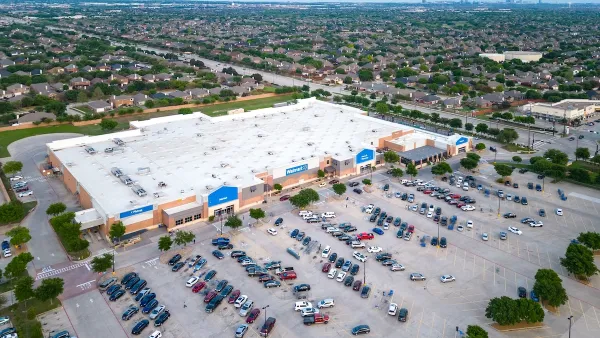
Is Driving Traffic to Big Box Stores True Economic Development?
Strong Towns’ Charles Marohn argues that planning for ‘commerce’ perpetuates an unsustainable, car-centric development model.
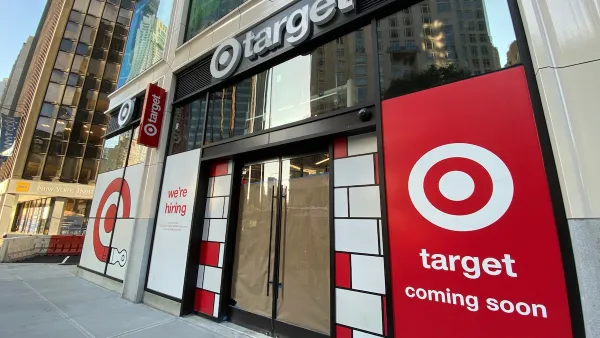
Why Big Box Stores Are Abandoning Their Urban Experiment
And why that may not be such a bad thing.
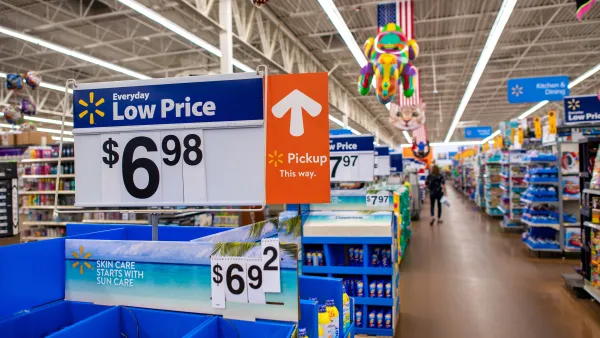
The Walkable Urbanism of Big Box Stores
For residents of many U.S. small towns and exurbs, the local Walmart offers a surprising benefit missing elsewhere in their communities: walkability.

Planetizen Federal Action Tracker
A weekly monitor of how Trump’s orders and actions are impacting planners and planning in America.

California plans to bury El Niño’s downpour
If the state plays its cards right, it may be able to store a billion acre-feet of El Niño’s water in aquifers.

Desperate measures: Advocates weigh draining Lake Powell to fill Colorado River
Draining the reservoir could reduce evaporation losses by a couple hundred thousand acre-feet.

Los Angeles just elected an urban planner as its mayor
Transportation analysts are optimistic that Raman will be more aggressive in addressing transit issues than Bass.

Mamdani’s pied-à-terre tax survives legal challenge
A panel of judges found that the plaintiffs failed to demonstrate injury as a result of New York City's implementation of the tax.

Eastern Nebraska is running out of electricity
Data centers and electrification are straining eastern Nebraska’s grid, throttling economic development.

FREE Course: Walkable City 1: Why Walkability?
After describing his path towards focusing on walkability as the essence of good planning, Jeff Speck marches through his five principal reasons for making more walkable places.
Reinventing Malls: Planning Alchemy—Turning Gray Fields Into Gold
The course focuses on the opportunities and imperatives that shape reinvention of mall sites.

City of Rosemead
Rutgers University, Edward J. Bloustein School of Planning and Public Policy
One Hundred Miles
University of Michigan School for Environment and Sustainability (SEAS)
Hunter College, City University of New York (CUNY)
The Architects Foundation
City of Cambridge
Montrose County
The Pocatello Development Authority