Statistics Canada has released more data from the 2011 Census, this time focusing on household composition and type of dwelling. The data finds that growth in housing stock in Canada's larger cities is tied to high-rise living.


The development of high-rise dwellings is also connected to the high cost of the housing markets in big cities such as Toronto and Vancouver, where middle incomes can't keep up with prices. This has led to developers offering ever smaller units, in some cases less than 30 square meters. According to the Vancouver Sun,
"Statistics Canada's latest census data shows that high-rises have sprouted up across the country, with the stock expanding 10.7 per cent between 2006 and 2011. In Vancouver, the market is on fire [having expanded] 24 per cent in five years.
[T]he data show that most people still live in single family homes. About 55 per cent of all housing in Canada is this type of dwelling, about the same as in 2006. High-rises only make up a tenth of the country's housing stock, despite the fast pace of building. But that's less true in the big cities. Toronto and Vancouver in particular have seen double-digit expansion of high rises and a more moderate rate of growth in single detached homes. Now, more than a quarter of Toronto homes and 15 per cent of Vancouver dwellings are in high-rise buildings."
Read the full story: Census reveals growth in high-rise apartments, especially in big cities

Is the built environment partly to blame for population decline?
The way communities are designed could be contributing to lower birth rates.

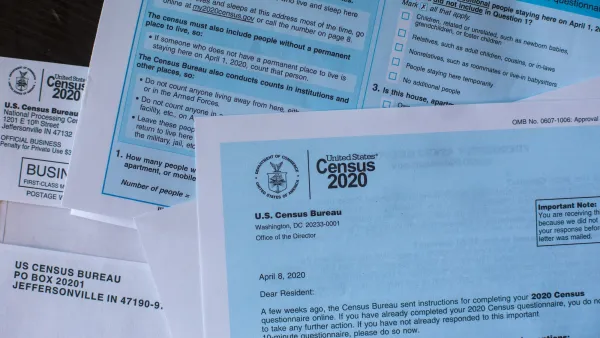
US Census Starts Using Postal Workers as Census Takers
A test program is using postal carriers to administer Census questionnaires.
Republicans are Pushing to Make the American Community Survey Voluntary. History Shows That’s a Death Sentence for Data.
A voluntary survey will make demographic data “less accurate, less available, and less useful” — and for some rural communities, “a total blackout.”

Planetizen Federal Action Tracker
A weekly monitor of how Trump’s orders and actions are impacting planners and planning in America.

California plans to bury El Niño’s downpour
If the state plays its cards right, it may be able to store a billion acre-feet of El Niño’s water in aquifers.

Desperate measures: Advocates weigh draining Lake Powell to fill Colorado River
Draining the reservoir could reduce evaporation losses by a couple hundred thousand acre-feet.

Chicago voters approve permanent festival grounds, penalty for vacant property owners
Currently, major summer and fall festivals take over public parks for weeks at a time, drawing criticism from nearby residents

NYC votes to cut outdoor dining red tape, speed up permitting
New York City also voted to allow the Department of Transportation to begin work on urgent projects before notifying elected officials.

California appears to reject Prop. 45
The proposition would have expanded the projects that qualify for a streamlined environmental review, effectively paring down the California Environmental Quality Act.

FREE Course: Walkable City 1: Why Walkability?
After describing his path towards focusing on walkability as the essence of good planning, Jeff Speck marches through his five principal reasons for making more walkable places.
Reinventing Malls: Planning Alchemy—Turning Gray Fields Into Gold
The course focuses on the opportunities and imperatives that shape reinvention of mall sites.

City of Rosemead
Rutgers University, Edward J. Bloustein School of Planning and Public Policy
One Hundred Miles
Hunter College, City University of New York (CUNY)
The Architects Foundation
University of Cincinnati Online
City of Cambridge
Montrose County
The Pocatello Development Authority