Dr. Jay Apt offers four cost-effective steps for cities to maintain essential services when the next big blackout hits.


Major power outages can greatly impact a city's ability to carry out basic functions and services. It would be impossible to predict or avoid blackouts altogether, says Apt, but what cities and agencies like bus companies, hospitals and grocery stores can do is work to ensure a minimal impact on their provision of essential services.
Apt's first suggestion is for companies, agencies and residents to "list, in order of importance, the critical missions that are provided by electric power-and that, if not fulfilled, would have serious consequences." The second step is to highlight the weak links within an agency or group's emergency back-up plan. Additional suggestions include implementing cost-effective technologies to mitigate outages and incentives to induce emergency power-sharing.
It's up to cities, says Apt, to prepare for outages so that businesses and governments can continue to provide for us even when we're off the grid.
Read the full story: Blackouts Are a Fact of Life. Let's Deal With Them.

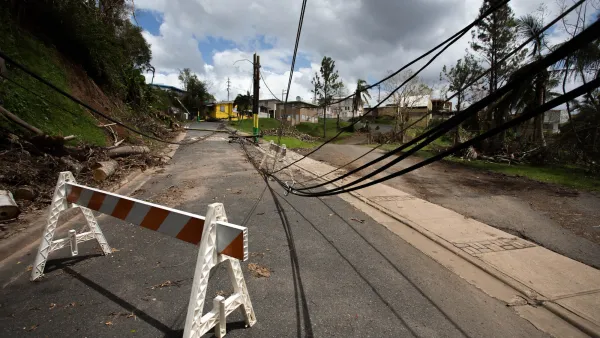
Bad Bunny's Iconic Electrical Pole Moment Highlights Puerto Rico’s Devastating Power Outages
The Reggaeton star’s halftime show included countless nods to his homeland, including a reference to the island’s ongoing power crisis.
World's Biggest Blackout Cripples India
For the second day in a row, massive blackouts have brought India's cities to a standstill as trains, traffic lights, and ATMs failed in New Delhi and throughout 14 states across the north and east of the country.
Perils Of Green Energy
As renewables replace polluting, carbon-intensive power sources, the reliability of the nation's electricity will be impaired because of the inability of the grid to accommodate power produced from distant sources, according to a new report.

Planetizen Federal Action Tracker
A weekly monitor of how Trump’s orders and actions are impacting planners and planning in America.

California plans to bury El Niño’s downpour
If the state plays its cards right, it may be able to store a billion acre-feet of El Niño’s water in aquifers.

Chicago breaks ground on $3 billion megadevelopment
The new neighborhood, titled Foundry Park, will one day host 3,700 residences.

California High-Speed Rail Authority CEO resigns after $600,000 scandal
Under Ian Choudri, the authority used taxpayer dollars to fund first class flights and trips to nightclubs.

Want to study the Missouri River? Soon, you may need unanimous approval from 10 states
Legislation would require 10 governors’ permission to study or build projects moving water outside the basin.

Desperate measures: Advocates weigh draining Lake Powell to fill Colorado River
Draining the reservoir could reduce evaporation losses by a couple hundred thousand acre-feet.

FREE Course: Walkable City 1: Why Walkability?
After describing his path towards focusing on walkability as the essence of good planning, Jeff Speck marches through his five principal reasons for making more walkable places.
Reinventing Malls: Planning Alchemy—Turning Gray Fields Into Gold
The course focuses on the opportunities and imperatives that shape reinvention of mall sites.

City of Rosemead
Rutgers University, Edward J. Bloustein School of Planning and Public Policy
One Hundred Miles
Hunter College, City University of New York (CUNY)
The Architects Foundation
University of Cincinnati Online
City of Cambridge
Montrose County
The Pocatello Development Authority