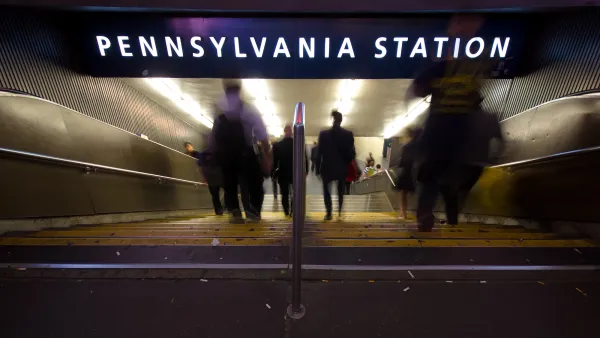
While the decades long effort to augment and improve New York's atrocious Penn Station have stalled, D.C. is moving ahead with plans to expand Union Station and redevelop the land above its tracks. Fred A. Bernstein looks at the two projects.


First the good news: with the purchase of the air rights over Union Station's train yard by developer Akridge, a project to build a 3 million
square-foot mixed use development and build "a vast new, glass-roofed train shed" adjacent to the elegant Daniel Burnham-designed station seem set to proceed.
A 3-hour Acela train ride to the north, "plans for replacing New York's Penn Station, the famously disgraceful
hole under Madison Square Garden, with a more respectable facility in
the Farley Post Office building on the West Side of Eighth Avenue-first
proposed by Senator Daniel Patrick Moynihan in 1993-are in limbo," writes Bernstein.
While there is a modicum of good news at Penn Station, where a $148 million contract
has been awarded to "create street entrances to an
existing concourse under the steps of the post office... the station itself, once designed by David Childs
of Skidmore, Owings and Merrill with a luminous ticketing hall in the
courtyard of the old post office building, is still on hold."
"But even moving Amtrak's operations to a new Moynihan Station wouldn't
help 90 percent of the commuters who use Penn Station every day," notes Bernstein. "The
only way to create a new train station on that site would be to move the
Garden-and right now, the Dolan family, owners of the arena, are happy
where they are...Meanwhile, the Metropolitan
Transportation Authority (yet another stakeholder) has hired the Los
Angeles office of AECOM to undertake a $7.7 million study of ways of
making the existing Pennsylvania Station less ghastly-called Penn
Station Vision-a strong sign that the station won't be replaced anytime
soon."
Read the full story: A Tale of Two Stations


New Penn Station design calls for ample public seating — a rare commodity in US public spaces
Amtrak's renderings show benches throughout the station.
New Penn Station design won't move Madison Square Garden
Amtrak and federal officials agreed on a new plan for the station's redesign that may be largely funded by the federal government.

Trump Plans Takeover of DC's Union Station
USDOT says it will take over management duties for the commercial spaces managed by Amtrak since last year and address the building’s infrastructure needs.

Planetizen Federal Action Tracker
A weekly monitor of how Trump’s orders and actions are impacting planners and planning in America.

California plans to bury El Niño’s downpour
If the state plays its cards right, it may be able to store a billion acre-feet of El Niño’s water in aquifers.

Desperate measures: Advocates weigh draining Lake Powell to fill Colorado River
Draining the reservoir could reduce evaporation losses by a couple hundred thousand acre-feet.

In Texas, data centers are swallowing promised parkland
Residents who moved to Taylor, Texas for a rural community now have to contend with three data centers in their backyard.

How a Chicago-sized wind farm beat the odds and powered on
The project spanned five presidential administrations and a standoff with a U.S. military base.

MTA gives itself 30 days to transform pit into basketball court
The site has been under construction since 2022; the city originally estimated it would finish the court in 2024.

FREE Course: Walkable City 1: Why Walkability?
After describing his path towards focusing on walkability as the essence of good planning, Jeff Speck marches through his five principal reasons for making more walkable places.
Reinventing Malls: Planning Alchemy—Turning Gray Fields Into Gold
The course focuses on the opportunities and imperatives that shape reinvention of mall sites.

City of Rosemead
Rutgers University, Edward J. Bloustein School of Planning and Public Policy
One Hundred Miles
Hunter College, City University of New York (CUNY)
The Architects Foundation
University of Cincinnati Online
City of Cambridge
Montrose County
The Pocatello Development Authority