As the city of Bordeaux, France, makes plans to move up the list of major European cities, it's calling on a multidisciplinary design competition for ways to revitalize its city from the top down by integrating "natural areas."


As issues of global warming and climate change continue to play a prominent role in planning and political discourse, more cities are looking to nature for its sustainable and restorative qualities. A design competition in southern France called Bordeaux 55,000 challenges five multidisciplinary teams of designers to come up with the most innovative idea of "how best to transform 55,000 hectares (136,000 acres) into natural areas," reports John Thackara.
The teams include specialists in the areas of architecture, landscape, geography and ecology, to name a few, and are focusing their attention on revitalizing the major areas of focus which include "the heart of the city; major adjacent agricultural and forest areas; enhancement of wetlands or flood plains; and various wastelands."
One of the major challenges faced with these sorts of design competitions, writes Thackara, is creating a design that is more than just a pretty idea, but can actually be translated into reality. What sets this competition apart from many others are requirements for the five multidisciplinary teams to integrate the "concept of resilience, and the design principles of permaculture, in developing their proposals."
Read the full story: Top Down Nature

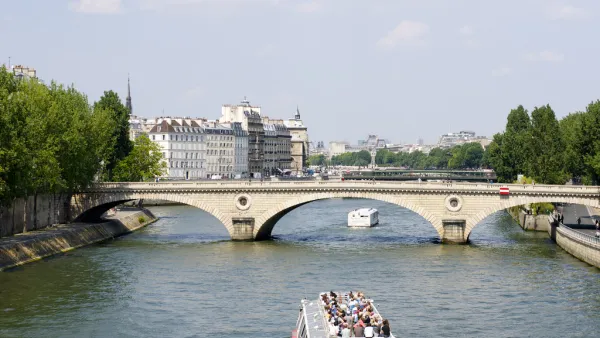
Paris Prepares for the Worst With a Flood Drill
If the Seine rises to historic levels, Paris officials want to be ready. Earlier this month, an 11-day drill sought to prepare the city for what would happen if the Seine and Marne Rivers rose above their banks.
Testing the Many Aspects of Waterfront Resilience—In New York City
Principals from the Rebuild by Design competition, focusing on Red Hook in Brooklyn and Hunts Point in the South Bronx, discussed their designs and philosophies regarding New York City's resilience at the Center for Architecture.
Rebuild By Design: Building Resilience along the Atlantic Coast
Rebuild By Design, a design competition under the purview of the Department of Housing and Urban Development, released ten final proposals for projects that could protect and strengthen the Atlantic Coast in the event of another Hurricane Sandy.

Planetizen Federal Action Tracker
A weekly monitor of how Trump’s orders and actions are impacting planners and planning in America.

Amtrak, CN end decades-long dispute with eight-year agreement
The new operating agreement establishes an updated framework for the companies to work together, including processes to resolve disputes.

Judges permit Denver to divert 77,000 acre feet from the Colorado River for reservoir expansion
Overuse and climate change have caused the Colorado River’s water levels to plummet.

NYC DOT wants faster, more permanent street upgrades
The city is examining ways to build more concrete infrastructure without getting entangled in 'decades-long' projects.

'Something we’ve never seen before:' rising utility rates could strain city finances nationwide
Data centers, climate change and other factors have caused utility rates in the United States to increase by 38% since 2020.

Trump to overrule local leaders, lease millions of acres of America’s Pacific Island territories’ seafloors to mining companies
International law says that the Indigenous people of America’s territories have a right to prior and informed consent regarding projects that impact their countries.

FREE Course: Walkable City 1: Why Walkability?
After describing his path towards focusing on walkability as the essence of good planning, Jeff Speck marches through his five principal reasons for making more walkable places.
Reinventing Malls: Planning Alchemy—Turning Gray Fields Into Gold
The course focuses on the opportunities and imperatives that shape reinvention of mall sites.

Harvard University Graduate School of Design
KFH Group Inc.
Greater Baltimore Committee
The Architects Foundation
University of Cincinnati Online
The Pocatello Development Authority
The Urban Renewal Agency of the City of Pocatello