Alexandria Abramian Mott spotlights several grassroots ways -- from signs to screams -- in which "fed-up residents are reclaiming their streets, or at least trying to."


Is it time to bid adieu to the much derided speed hump? Mott profiles the efforts of several Southern Californians who have taken traffic-calming into their own hands with creative and innovative solutions.
One project highlighted is the road mural painted by Joe Linton, artist and organizer for the L.A. walking and biking event CicLAvia, and his fellow neighbors in the Koreatown section of Los Angeles. "'I think it really works to slow cars down,' Linden said of the mural at the T intersection of Bimini Place and White House Place. He said the artwork helps to take drivers out of their typical 'just-have-to-get-to-their-destination' frame of mind and makes them realize that 'streets are public spaces where people can really interact.'"
Another, perhaps less successful but more prevalent, practice profiled is screaming, as demonstrated by "vigilante Eric Lapidus," who "routinely shouts at drivers flying down his tree-lined Spaulding Square avenue."
The result? "'Sometimes people do slow down,' Lapidus said. But is the occasional victory worth the vocal cord strain? 'Hardly,' Lapidus said. 'But it helps relieve the anger I feel when I see people blasting down our street when kids are playing ball just a few feet from them.'"
Read the full story: DIY speed bumps: Traffic control for neighborhoods
Canadian Officials See Long-Term Threat from Short-Term Urbanism
A series of tactical urbanist interventions inspired by a recent talk given by Mike Lydon, Principal of the Street Plans Collaborative, have raised the ire of the powers that be in the Canadian city of Hamilton.
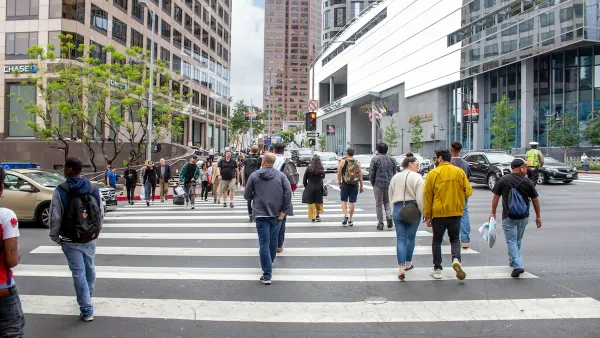
LA residents may be allowed to paint their own crosswalks
Councilwoman Katy Yaroslavsky put out a motion instructing the Los Angeles Department of Public Transportation to study the feasibility of allowing volunteers to paint crosswalks.
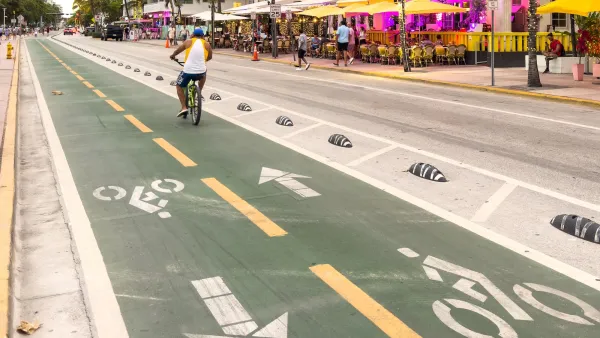
FHWA removes bike lanes and speed cameras from list of traffic safety measures
The agency did not announce its intention to eliminate five proven safety measures from its list of suggested interventions.

Planetizen Federal Action Tracker
A weekly monitor of how Trump’s orders and actions are impacting planners and planning in America.

California plans to bury El Niño’s downpour
If the state plays its cards right, it may be able to store a billion acre-feet of El Niño’s water in aquifers.

Desperate measures: Advocates weigh draining Lake Powell to fill Colorado River
Draining the reservoir could reduce evaporation losses by a couple hundred thousand acre-feet.

Mamdani’s pied-à-terre tax survives legal challenge
A panel of judges found that the plaintiffs failed to demonstrate injury as a result of New York City's implementation of the tax.

Eastern Nebraska is running out of electricity
Data centers and electrification are straining eastern Nebraska’s grid, throttling economic development.

Seattle passes record-breaking transit services expansion
Proposition 1 will double the city’s transit tax to add 95,000 more bus trips and preserve 180,000 bus trips annually.

FREE Course: Walkable City 1: Why Walkability?
After describing his path towards focusing on walkability as the essence of good planning, Jeff Speck marches through his five principal reasons for making more walkable places.
Reinventing Malls: Planning Alchemy—Turning Gray Fields Into Gold
The course focuses on the opportunities and imperatives that shape reinvention of mall sites.

City of Rosemead
Rutgers University, Edward J. Bloustein School of Planning and Public Policy
One Hundred Miles
University of Michigan School for Environment and Sustainability (SEAS)
Hunter College, City University of New York (CUNY)
The Architects Foundation
City of Cambridge
Montrose County
The Pocatello Development Authority