In what Deputy Prime Minister Nick Clegg calls a "dramatic power shift", England's largest cities have gained new powers to control their economies and transportation, reports Sam Lister.


Seeing the potential to spur economic and job growth over the next two decades, the major English cities of Liverpool, Manchester, Birmingham, Bristol, Leeds, Newcastle, Nottingham and Sheffield have all reached agreement with the central government to gain more control over infrastructure and investment decisions.
According to Clegg, the deals, whose terms vary by city, amount to "an unprecedented transfer of power from central government to local communities."
"They are the economic powerhouses of England," says Clegg, "so it makes sense that the cities decide for themselves how to boost their local economies."
Chris Berkin, writing in Construction News, notes that, "Many cities will combine with other regional authorities in order to more effectively deliver planning and infrastructure."
Read the full story: Nick Clegg to announce extra powers for cities

Route for England's New High-Speed Rail Line Unveiled
This week, the UK government announced the controversial route for phase 2 of "the first major railway line north of London since Victorian times." The line, dubbed HS2, will halve journey times between northern cities and to the capital.
Three High Speed Rail Lines Announced in UK
The three new high speed rail lines are being called the biggest advancement of the United Kingdom's public transit system in more than 50 years.
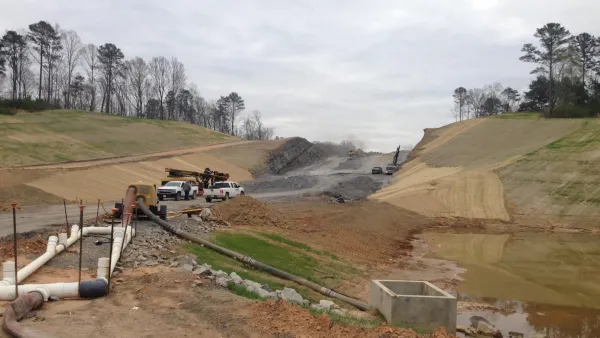
Alabama DOT wants to fill wetlands for interstate project
The Birmingham Northern Beltline would run roughly 52 miles through forests and wetlands that are home to multiple endangered species.

Planetizen Federal Action Tracker
A weekly monitor of how Trump’s orders and actions are impacting planners and planning in America.

Amtrak, CN end decades-long dispute with eight-year agreement
The new operating agreement establishes an updated framework for the companies to work together, including processes to resolve disputes.

Judges permit Denver to divert 77,000 acre feet from the Colorado River for reservoir expansion
Overuse and climate change have caused the Colorado River’s water levels to plummet.

Boston has spent millions making the Green Line more accessible — and there’s no end in sight
While the city has invested millions into expanding and adding platforms to the Green Line to make it more accessible, new train cars set to arrive next year will be too tall for disabled passengers to board without raising the current platforms.

Idaho may see an 18% drop in federal surface transit funding — the largest estimated cut in the US
Transit systems in rural communities are much more reliant on federal funding to provide their services.

How ‘post-disaster gentrification’ alters neighborhoods after natural calamities
After hurricanes, fires or other calamities, the original residents of a community are often replaced by younger, wealthier residents.

FREE Course: Walkable City 1: Why Walkability?
After describing his path towards focusing on walkability as the essence of good planning, Jeff Speck marches through his five principal reasons for making more walkable places.
Reinventing Malls: Planning Alchemy—Turning Gray Fields Into Gold
The course focuses on the opportunities and imperatives that shape reinvention of mall sites.

City of Wisconsin Rapids
Harvard University Graduate School of Design
KFH Group Inc.
The Architects Foundation
University of Cincinnati Online
The Pocatello Development Authority
The Urban Renewal Agency of the City of Pocatello