In a discussion at the Automotive News Europe Congress in Monte Carlo last week, panelists said the trend towards urbanization will require making cars part of a larger eco-system of transportation.


Panelists like Barb Samardzich, vice president of product development at Ford Europe, said that that automakers will have to "radically change their business models":
Looking into the 2050 timeframe, one thing is for certain, the transportation system will be an eco-system that integrates all modes of travel together," said Samardzich, in an article by Automobile News reporter Nick Gibbs. The subject of the panel was "Future Mobility", so the prognosticating wasn't coming from left field. Yet the panel was surprisingly in synch with their message.
"The four panelists all cited the shift toward urban living as the force behind integrated and connected transport. "Urbanization is the megatrend we have to take into account," said Claus Ehlers, director of society, vehicle concepts and human factors at Daimler."
Read the full story: Automakers must adapt business models to embrace future transport systems

NHTSA Launches Investigations Into Two More Self-Driving Automakers
The federal agency is responding to reports of crashes and erratic behavior from Waymo and Zoox vehicles.
Ford Introduces Dooring Prevention Feature
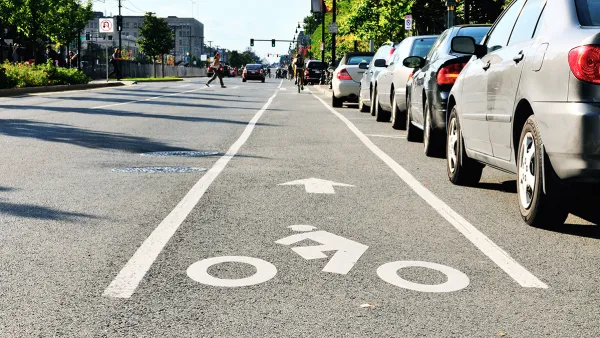
The company’s 2024 Mustang models will include an Exit Warning to prevent drivers from hitting cyclists when opening their doors.

Friday Eye Candy: AI Envisions Solutions to the Challenges Facing Cities
Phoenix reimagined for shade. Los Angeles as a place where everybody walks. San Francisco with affordable housing. AI makes a vision of the future possible.

Planetizen Federal Action Tracker
A weekly monitor of how Trump’s orders and actions are impacting planners and planning in America.

California plans to bury El Niño’s downpour
If the state plays its cards right, it may be able to store a billion acre-feet of El Niño’s water in aquifers.

Desperate measures: Advocates weigh draining Lake Powell to fill Colorado River
Draining the reservoir could reduce evaporation losses by a couple hundred thousand acre-feet.

NITA’s first budget outlines $5 billion operating plan
The plan also proposes a $9.73 billion capital program for 2027 through 2031.

In Texas, data centers are swallowing promised parkland
Residents who moved to Taylor, Texas for a rural community now have to contend with three data centers in their backyard.

How a Chicago-sized wind farm beat the odds and powered on
The project spanned five presidential administrations and a standoff with a U.S. military base.

FREE Course: Walkable City 1: Why Walkability?
After describing his path towards focusing on walkability as the essence of good planning, Jeff Speck marches through his five principal reasons for making more walkable places.
Reinventing Malls: Planning Alchemy—Turning Gray Fields Into Gold
The course focuses on the opportunities and imperatives that shape reinvention of mall sites.

City of Rosemead
Rutgers University, Edward J. Bloustein School of Planning and Public Policy
One Hundred Miles
Hunter College, City University of New York (CUNY)
The Architects Foundation
University of Cincinnati Online
City of Cambridge
Montrose County
The Pocatello Development Authority