What should planners take away from last week's barrage of polls about Americans' attitudes?


Ben Brown looks at important trends and disconnects key to planners. With loyalties tightly focused at local levels, outside specialists will have a hard time unless they tap into the hierarchy of trust. But locals aren't so sure about the people and organizations most able to help.
While the most-trusted leadership with 43 percent of responses are "neighborhood representatives" and "business professionals," Brown points out that, "Most of the biggest challenges to community health - whether you're measuring health by environmental, social or economic metrics - come at us from levels behind local control."
"To get beyond the frustration about this persistent disconnect, planners have to extract from these issue rankings an updated version of the old 'Think global, act local' principle. Too often, we insist on starting with issues like sprawl and climate change, then deducing from those problems the contributions to global solutions that can be made at the local level. That's a losing strategy."
Thanks to Hazel Borys
Read the full story: We’re OK. Ya’ll, Not So Much: Your guide to understanding national polls
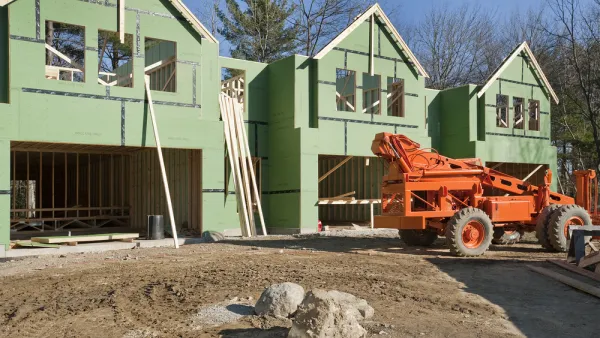
Affordable Housing Finance: Show Me the Money
Ben Brown continues his weekly blog series in lead-up to the day-long exploration at CNU Savannah, "Affordability: The Intersection of Everything."
Achieving Community: Let's Get Real
The benefits of authentic community are extensive. Maybe even transcendent. But how do we get to that point? Scott Doyon's latest blog has a few thoughts.

Unpredictable, High Risk, High Cost: Planning for the Worst Is the Worst
Ben Brown takes a hard look at our capacities and limitations in a world more complex than we’d prefer.

Planetizen Federal Action Tracker
A weekly monitor of how Trump’s orders and actions are impacting planners and planning in America.

Eastern Nebraska is running out of electricity
Data centers and electrification are straining eastern Nebraska’s grid, throttling economic development.

Study reveals best places in the U.S. for cycling, walking
New research from Streetlight Data examines bicycle and pedestrian miles per capita in the 100 largest U.S. cities by population.

DSA members accuse Mamdani of 'abandoning values' over housing redevelopment
New York City's mayor plans to replace about 2,000 units of public housing with private, mixed-income housing.

All sides of BRT debate unhappy with CDOT’s most recent move
The Colorado Department of Transportation is no longer considering center-running bus lanes for Colorado Boulevard.

Massachusetts bogs generate both power, and cranberries
Putting solar panels above farmland is one way Massachusetts is advancing toward its goal of net-zero carbon emissions by 2050.

FREE Course: Walkable City 1: Why Walkability?
After describing his path towards focusing on walkability as the essence of good planning, Jeff Speck marches through his five principal reasons for making more walkable places.
Reinventing Malls: Planning Alchemy—Turning Gray Fields Into Gold
The course focuses on the opportunities and imperatives that shape reinvention of mall sites.

City of Rosemead
Rutgers University, Edward J. Bloustein School of Planning and Public Policy
One Hundred Miles
University of Michigan School for Environment and Sustainability (SEAS)
Hunter College, City University of New York (CUNY)
The Architects Foundation
City of Cambridge
The Pocatello Development Authority
The Urban Renewal Agency of the City of Pocatello