Michael Kimmelman pays homage to an angular glass canopy, designed by architect Preston Scott Cohen, that has turned a pedestrian street in Lower Manhattan into a "social cathedral."


Covering 11,000 square feet of North End Way, "an obscure but busy pedestrian street" near One World Trade Center, the angular glass canopy "elevates what is really just a gap between two buildings into something almost as inspired as the nave of a great Gothic cathedral," writes Kimmelman.
So what is the secret to the canopy's charm? According to Kimmelman, the canopy's success is rooted in a deft handling of the tension between constraint and freedom by its designer. The canopy "is composed of three tilting, jagged triangles. Picture giant shards of glass. They filter light gracefully through enameled panes, the light shifting with the passing day. The longest triangle is Mr. Cohen's big statement: It slices the arcade, which bends toward the south end, along the diagonal. That sweeping diagonal brings together what could otherwise be - precisely because North End Way isn't straight - a disjointed space. Stretching the length of the easement, the diagonal provides counterpoint to the regular beat of the canopy's steel ribbing and the modules of 200 West's facade."
"This all may sound complicated, but there's an elegant simplicity to the three triangles slung from the same long wall. Those glass planes explode outward, upward and downward from the horizontal line where the canopy connects to 200 West. The tension between that steady horizontal and the fun-house effects of the triangles is what gives North End Way its architectural drama."
Read the full story: A Canopy as Social Cathedral

In Battery Park City, Public Infrastructure Meets Climate Resilience
A massive project underway in Lower Manhattan seeks to protect the shoreline from future flooding and mitigate the effects of climate change and rising sea levels.
Silo-Breaking Sustainability or Real-Life Lorax: L.A.’s First City Forest Officer
The city of L.A.’s first city forest officer, Rachel Malarich, opines on her new role in facilitating cooperation between the city’s departments to achieve a more equitable urban canopy.
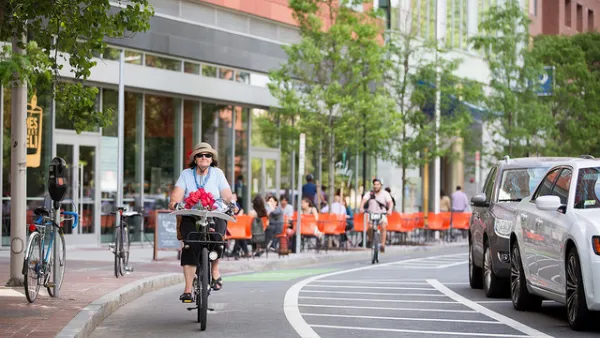
10 Best Bike Lanes of the Year Announced
The victories keep piling up for the advocates, bureaucrats, and politicians fighting for more and better bike infrastructure.

Planetizen Federal Action Tracker
A weekly monitor of how Trump’s orders and actions are impacting planners and planning in America.

California plans to bury El Niño’s downpour
If the state plays its cards right, it may be able to store a billion acre-feet of El Niño’s water in aquifers.

Desperate measures: Advocates weigh draining Lake Powell to fill Colorado River
Draining the reservoir could reduce evaporation losses by a couple hundred thousand acre-feet.

Los Angeles just elected an urban planner as its mayor
Transportation analysts are optimistic that Raman will be more aggressive in addressing transit issues than Bass.

Mamdani’s pied-à-terre tax survives legal challenge
A panel of judges found that the plaintiffs failed to demonstrate injury as a result of New York City's implementation of the tax.

Eastern Nebraska is running out of electricity
Data centers and electrification are straining eastern Nebraska’s grid, throttling economic development.

FREE Course: Walkable City 1: Why Walkability?
After describing his path towards focusing on walkability as the essence of good planning, Jeff Speck marches through his five principal reasons for making more walkable places.
Reinventing Malls: Planning Alchemy—Turning Gray Fields Into Gold
The course focuses on the opportunities and imperatives that shape reinvention of mall sites.

City of Rosemead
Rutgers University, Edward J. Bloustein School of Planning and Public Policy
One Hundred Miles
University of Michigan School for Environment and Sustainability (SEAS)
Hunter College, City University of New York (CUNY)
The Architects Foundation
City of Cambridge
Montrose County
The Pocatello Development Authority