Michael Kimmelman ventures to Colombia's reborn second city to explore what new buildings and infrastructure have brought to the city's residents, what it has not, and what remains to be done.


Home to a cultural and social transformation attributed to the construction of infrastructure and glamorous architecture under the guidance of Sergio Fajardo, the governor of the region who was the city's mayor from 2004 to 2007, Kimmelman tells a more nuanced story. "The city's transformation established roots before Mr. Fajardo took office, in thoughtful planning guidelines, amnesties and antiterrorism programs, community-based initiatives by Germany and the United Nations and a Colombian national policy mandating architectural interventions as a means to attack poverty and crime."
Kimmelman also seeks to tell a larger story about the indelible connection between the physical and social environments. "Around the world, followers of architecture with a capital A have focused so much of their attention on formal experiments, as if aesthetics and social activism, twin Modernist concerns, were mutually exclusive. But Medellín is proof that they're not, and shouldn't be. Architecture, here and elsewhere, acts as part of a larger social and economic ecology, or else it elects to be a luxury, meaningless except to itself."
Read the full story: A City Rises, Along With Its Hopes
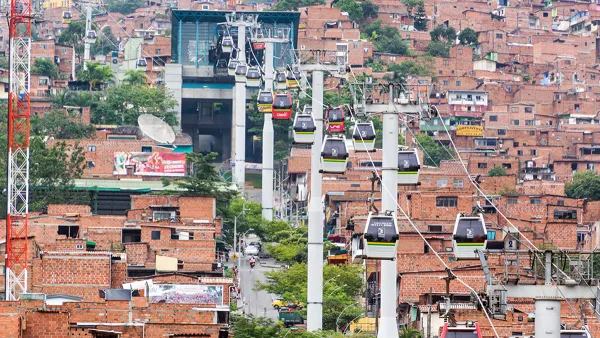
Infrastructure Investment for Public Safety: Lessons from Medellín
A natural experiment in Medellín indicates that infrastructural investments can reduce crime and improve perceptions of public safety.
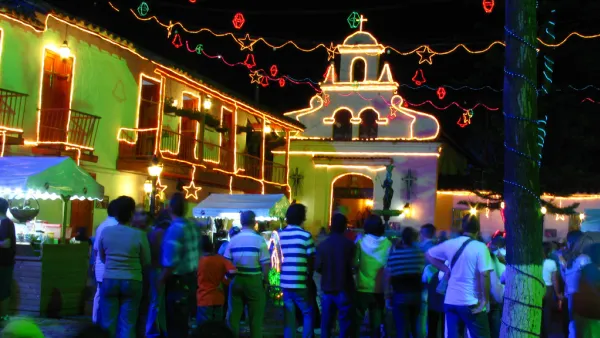
Colombia's Carbon Neutral Christmas Wonderland
Medellín's spectacular holiday lights display draws thousands of tourists to Colombia's second-largest city every year. Few visitors are likely to realize that the energy intensive displays are carbon neutral.
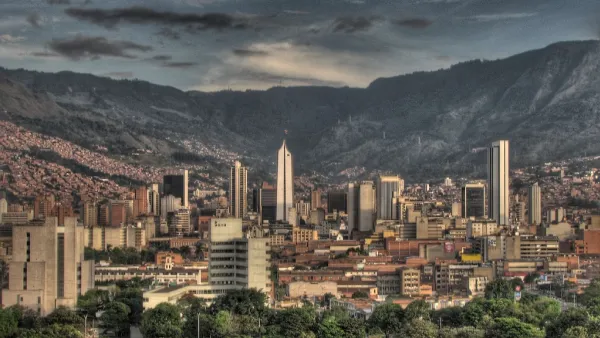
Medellin Chosen as 'Innovative City of the Year'
From an initial list of 200 candidates, Medellín, Colombia has been selected as the winner of The Wall Street Journal and Citi's “City of the Year” competition.

Planetizen Federal Action Tracker
A weekly monitor of how Trump’s orders and actions are impacting planners and planning in America.

Eastern Nebraska is running out of electricity
Data centers and electrification are straining eastern Nebraska’s grid, throttling economic development.

Study reveals best places in the U.S. for cycling, walking
New research from Streetlight Data examines bicycle and pedestrian miles per capita in the 100 largest U.S. cities by population.

Next-generation nuclear reactors are coming to Texas
The reactors will not require towering containment structures thanks to new safety features.

California distributes $1.3 billion to prevent transit service cuts, bolster projects
Twenty-eight projects across California received a portion of the funding.

Pennsylvania Democrats have 15 affordability, clean energy bills for flipped state Senate
Bills in consideration include a bill supporting geothermal energy and a bill supporting solar on warehouses.

FREE Course: Walkable City 1: Why Walkability?
After describing his path towards focusing on walkability as the essence of good planning, Jeff Speck marches through his five principal reasons for making more walkable places.
Reinventing Malls: Planning Alchemy—Turning Gray Fields Into Gold
The course focuses on the opportunities and imperatives that shape reinvention of mall sites.

City of Charlotte
City of Rosemead
Rutgers University, Edward J. Bloustein School of Planning and Public Policy
University of Michigan School for Environment and Sustainability (SEAS)
Hunter College, City University of New York (CUNY)
The Architects Foundation
City of Cambridge
The Pocatello Development Authority
The Urban Renewal Agency of the City of Pocatello