According to Tribune staff reporter Ameet Sachdev, "owners of the Chicago Cubs bought property across the street from Wrigley Field from McDonald's Corp. for $20 million, expanding their opportunities to redevelop areas around the stadium."


Sachdev writes that "a spokesman for Cubs Chairman Tom Ricketts said he and his family have not developed plans for the property yet."
"The area around Wrigley Field has become a lucrative entertainment district with bars, restaurants and rooftops catering to fans. But nearly all of the properties are owned by other landlords. ... Their original plan, which included the use of amusement taxes paid on Cubs tickets, received little political support. But the family continues to have conversations about public financing with Mayor Rahm Emanuel and members of the General Assembly," says Sachdev
Below, courtesy of the Chicago Tribune, is the view of the McDonald's restaurant, a parking lot and Wrigley Field at the intersection of Clark and Addison in Chicago. The Ricketts family has reportedly paid $20 million for the property which includes the McDonald's restaurant and a parking lot. (Antonio Perez/Chicago Tribune)

FULL STORY: Ricketts family buys McDonald's land across from Wrigley Field

New Public Space Outside Wrigley Field Just Another Win for Chicago
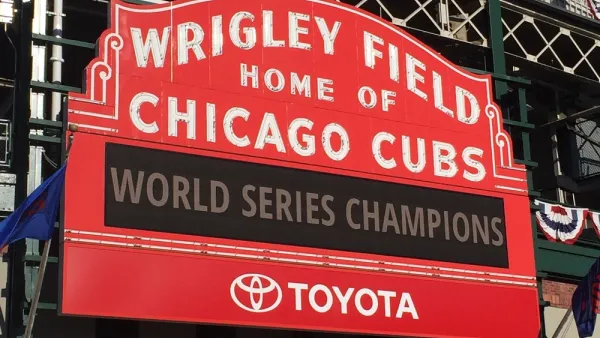
Chicago Cubs fans looking to bask in the glory of the team's first World Series victory since 1908 will find a new public plaza and lawn next to the stadium. The plaza will be open to the public on non-baseball days too.
City Nixes Idea to Shut Down More Streets for Cubs Games
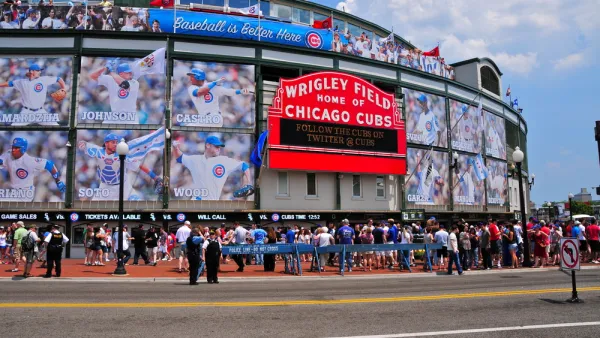
Any open streets benefits for a proposal to shut down Clark and Addison streets near Wrigley Field would have been secondary to security concerns—but it's all conjecture after the Mayor's Office nixed the idea.
Chicago Cubs Begin Renovations on Historic Wrigley Field
The controversial 1060 Project to renovate the Home of the Chicago Cubs broke ground over the weekend on a renovation proposal that will allow a mix of uses on the ballpark property.

Planetizen Federal Action Tracker
A weekly monitor of how Trump’s orders and actions are impacting planners and planning in America.

The state-sanctioned urbicide of Austin
People don’t kill cities. Freeways do.

US to reduce Colorado River water deliveries to Mexico
A new Colorado Treaty amendment reduces Mexico’s Colorado River water allocation by 250,000 acre feet.

Mamdani overhauls NYC's Vision Zero plan with 100 new policy goals
The overhaul aims to reduce traffic deaths and make streets safer for pedestrians, cyclists and drivers through lower speed limits, new safety infrastructure and more.

Amtrak not solely to blame for New Jersey commuter rail's unreliability, report finds
A new study from the Garden State Initiative found that NJ Transit’s budget grew 20% across a 4 year period, but reliability declined significantly over the same period.

EPA erases limits on planet-warming pollution from power plants
Under Monday’s plan, power plants would still have some limits on how much mercury, arsenic and other contaminants they can emit.

FREE Course: Walkable City 1: Why Walkability?
After describing his path towards focusing on walkability as the essence of good planning, Jeff Speck marches through his five principal reasons for making more walkable places.
Reinventing Malls: Planning Alchemy—Turning Gray Fields Into Gold
The course focuses on the opportunities and imperatives that shape reinvention of mall sites.

Eagle County Government
Harvard University Graduate School of Design
Nashville Planning Department
The Architects Foundation
University of Cincinnati Online
The Pocatello Development Authority
The Urban Renewal Agency of the City of Pocatello
Journal of the American Planning Association