The Globe and Mail profiles Victoria B.C.'s community of Dockside Green, which, in addition to being an infill development, is powered by a district energy system.


The development on Vancouver Island, British Columbia, is gaining international attention because of its success in implementing a district energy system fuelled by reclaimed construction waste.
"Dockside Green blooms on land that was long underused, faded industrial ground that was once home to whaling boats and shipbuilders. The neighbourhood is now bustling, vibrant and home to businesses and hundreds of people occupying about 270 units. [Its district energy] system...slashes the buildings' energy needs by more than 80 per cent [and] saves the community $500,000 a year. Another $100,000 is saved because green energy means carbon taxes don't have to be sent across the Victoria harbour to the treasury at the provincial legislature.
About one-third complete, (it opened in 2007-2008) it's being hailed as one of the greenest communities in the world."
Read the full story: Victoria's 'district energy' community a model for Canada and beyond
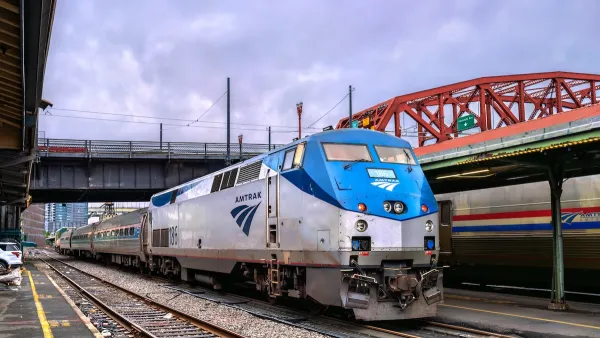
Transit leaders progress high-speed rail from Portland to Vancouver, B.C.
Washington state officials may reveal feasible routes for the high-speed rail in late 2027.

Budget constraints threaten light rail for Oregon, Washington’s new bridge
The current proposal includes only the infrastructure for the light rail, without funding for the train and tracks.
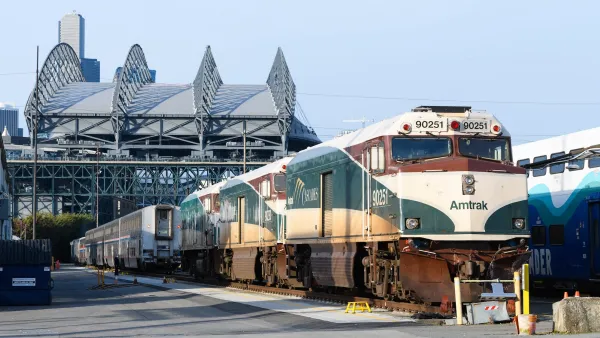
Amtrak opens border preclearance facility for travelers entering US from Vancouver
The first-of-its-kind facility streamlines the border crossing experience, eliminating long waits.

Planetizen Federal Action Tracker
A weekly monitor of how Trump’s orders and actions are impacting planners and planning in America.

California plans to bury El Niño’s downpour
If the state plays its cards right, it may be able to store a billion acre-feet of El Niño’s water in aquifers.

Desperate measures: Advocates weigh draining Lake Powell to fill Colorado River
Draining the reservoir could reduce evaporation losses by a couple hundred thousand acre-feet.

US buildings threatened, destroyed by fires set to triple by 2060
Researchers found a high fire risk for socioeconomically vulnerable neighborhoods in the American West.

LA residents may be allowed to paint their own crosswalks
Councilwoman Katy Yaroslavsky put out a motion instructing the Los Angeles Department of Public Transportation to study the feasibility of allowing volunteers to paint crosswalks.

Dallas moves to overhaul its zoning code
The city's zoning reform will allow more multi-family and mixed-use developments.

FREE Course: Walkable City 1: Why Walkability?
After describing his path towards focusing on walkability as the essence of good planning, Jeff Speck marches through his five principal reasons for making more walkable places.
Reinventing Malls: Planning Alchemy—Turning Gray Fields Into Gold
The course focuses on the opportunities and imperatives that shape reinvention of mall sites.

City of Rosemead
Rutgers University, Edward J. Bloustein School of Planning and Public Policy
One Hundred Miles
Hunter College, City University of New York (CUNY)
The Architects Foundation
University of Cincinnati Online
City of Cambridge
Montrose County
The Pocatello Development Authority