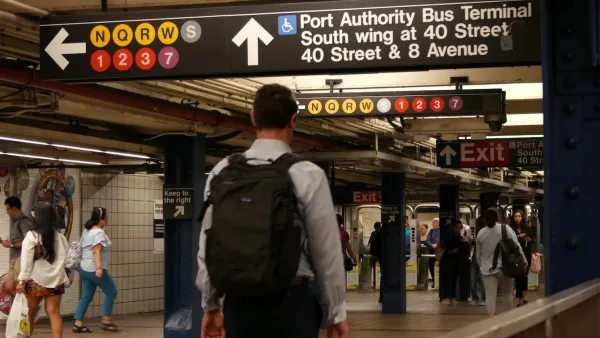
According to Alon Levy, the 7 line extension from New York City to Secaucus, NJ will get workers "almost to their jobs," but not quite. It may seem trivial, but literature on the penalty of certain transfers may be pointing to failure.


"Within urban rail, people transfer all the time. Perhaps the disutility of getting up while changing trains is not an issue when passengers do not expect to find a seat in the first place. Regional rail riders transfer as well, when the transfers are easy and there's no additional waiting time – in fact, setting up a timed transfer on a highly branched regional line increases the frequency on each branch, so any disutility from transferring is swamped by the more convenient schedule. What people don't normally do is ride a regional line that gets them almost to their job, and then take urban transit for the last mile."
Read the full story: Why the 7 to Secaucus Won’t Work
Subway Transfer Signage a No-Go in NYC
A recent guerrilla campaign designed to ease train-to-train transfer on the New York subway displeased both the MTA and regular commuters.

MTA to upgrade subway signals for entire network by 2050
This is the first time New York City has planned to modernize subway signals in the Bronx.
MTA looks to bring AI-assisted, multilingual announcement system to subways
Some of the transit agency’s audio systems haven’t been upgraded in 40 years.

Washington state to charge fee to drivers with fuel-efficient cars
Revenue from the fee will go towards supporting the state’s highways.

Illinois considers spending $1 billion in taxpayer money on data center
A quantum computing campus and data center are currently under construction in Chicago.

Trump to blast ‘hydrocarbon highway’ through ‘world’s longest art gallery’
Environmental and historic preservation groups are suing to stop the project.

NYC, state sue feds over mixed-immigration-status housing assistance rule
The state’s lawsuit argues that the rule change violates the Administrative Procedure Act.

Michigan to turn neighborhood into virtual power plant
Residents will soon be able to divert their excess energy to the grid in exchange for compensation.

Data center, mining project swarm to long-awaited Alaska railroad line
The state-owned railroad approved final plans for the spur line this week; the project is expected to cost $311 million, mostly funded by the federal government

FREE Course: Walkable City 1: Why Walkability?
After describing his path towards focusing on walkability as the essence of good planning, Jeff Speck marches through his five principal reasons for making more walkable places.
Reinventing Malls: Planning Alchemy—Turning Gray Fields Into Gold
The course focuses on the opportunities and imperatives that shape reinvention of mall sites.

City of Charlotte
City of Rosemead
Rutgers University, Edward J. Bloustein School of Planning and Public Policy
University of Michigan School for Environment and Sustainability (SEAS)
Hunter College, City University of New York (CUNY)
The Architects Foundation
University District Partnership