Wounded but far from dead, the WSJ examines the many problems plaguing California's formidable HSR project. With federal funding likely to be pulled by House Republicans, the Journal reports on the courses the project could take.


To be sure, it's not just high speed rail-hostile House Republicans that the California High Speed Rail Authority must confront. Opposition in the Central Valley has forced unexpected increased costs for the Bakersfield to Fresno 140-mile stretch. The Authority's revised business plan, already delayed, is due by Nov. 1 and will be scrutinized by a wary state legislature, though the Democratic majority and the governor remain backers of the $45 billion project.
"The California troubles reflect the difficulty of shifting a country that mainly relies on the automobile and airplane. The federal government and states have for decades built and maintained roads using a dedicated revenue stream, the federal gasoline tax of 18.4 cents per gallon. There is no such source of cash for high-speed rail, putting rail proponents at the mercy of political winds."
California has to-date received $3 billion in federal funds, and matched it from the 2008 $9 billion bond measure. The remaining $6 billion can only be applied as matching funds.
"Roelof van Ark, chief executive of the California rail authority, said private investors, including rail operators and construction companies from Europe and Asia, have voiced interest in high-speed rail. The catch: Investors want to see a link to San Francisco or Los Angeles closer to completion before they put in billions, he said. It is precisely that link for which the state needs money."
Read the full story: Plan for High-Speed Rail Just Inching Along

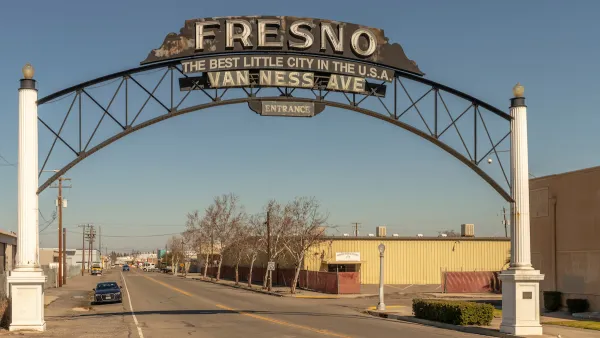
Fresno Pins Economic Hopes on High-Speed Rail
The Central Valley town anticipates an economic boost when the long-awaited California High-Speed Rail begins operations.
A Change of Direction for California High-Speed Rail
In the face of political opposition and mounting construction costs in Southern California, the state High-Speed Rail Authority has chosen to build north from the Central Valley to San Jose rather than south from Fresno to the San Fernando Valley.
California High Speed Rail Construction and Litigation Update
Notwithstanding a favorable court ruling freeing state bond funds, construction is delayed on the 800-mile project, reports Ralph Vartabedian of the LA Times. Jessica Calefati of the Mercury News writes on opponents' appeal to the state Supreme Court

Planetizen Federal Action Tracker
A weekly monitor of how Trump’s orders and actions are impacting planners and planning in America.

Amtrak, CN end decades-long dispute with eight-year agreement
The new operating agreement establishes an updated framework for the companies to work together, including processes to resolve disputes.

Judges permit Denver to divert 77,000 acre feet from the Colorado River for reservoir expansion
Overuse and climate change have caused the Colorado River’s water levels to plummet.

South Chicago development proposal would 'upzone' neighborhoods to increase density
The South Chicago Land Use Framework plan also aims to promote pedestrian and transit-oriented developments.

Boston has spent millions making the Green Line more accessible — and there’s no end in sight
While the city has invested millions into expanding and adding platforms to the Green Line to make it more accessible, new train cars set to arrive next year will be too tall for disabled passengers to board without raising the current platforms.

Idaho may see an 18% drop in federal surface transit funding — the largest estimated cut in the US
Transit systems in rural communities are much more reliant on federal funding to provide their services.

FREE Course: Walkable City 1: Why Walkability?
After describing his path towards focusing on walkability as the essence of good planning, Jeff Speck marches through his five principal reasons for making more walkable places.
Reinventing Malls: Planning Alchemy—Turning Gray Fields Into Gold
The course focuses on the opportunities and imperatives that shape reinvention of mall sites.

City of Wisconsin Rapids
Harvard University Graduate School of Design
KFH Group Inc.
The Architects Foundation
University of Cincinnati Online
The Pocatello Development Authority
The Urban Renewal Agency of the City of Pocatello