Researchers found in their analysis of 300 California municipalities that the cities that had slow growth or anti-growth policies were less impacted by the housing crisis, writes Mark Bergen for Forbes.


The authors say that their findings do not endorse strict growth policies, but that "Their data indicate that local maneuvers didn't affect the amount of development, but its allocation. A 'spillover effect' emerged, where restrictive land use in one region pushed new housing development into neighboring, more lax cities."
"'A lot of previous studies have assumed that cities are unable to resist larger macroeconomic forces,' Garrett Glasgow, one of the study's authors, wrote to me in an email. 'But at least in this case, we see evidence that city policies helped to mitigate the effects of a national foreclosure crisis."
Read the full story: Slow Growth In Cities May Have Minimized Foreclosures
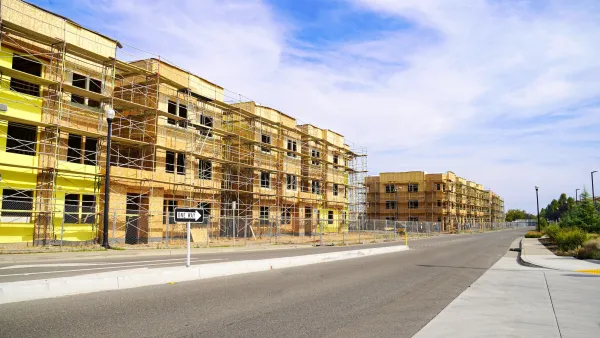
2025 Brought Seismic Changes to California Housing Laws
New state laws and policies created in reaction to devastating wildfires could spell massive changes for Southern California’s housing landscape.

Survey: 59% of LA Residents Want Dense Housing in Their own Neighborhoods
A UCLA survey reveals strong support for new apartments across the city, bucking the notion that Angelenos are NIMBYs.
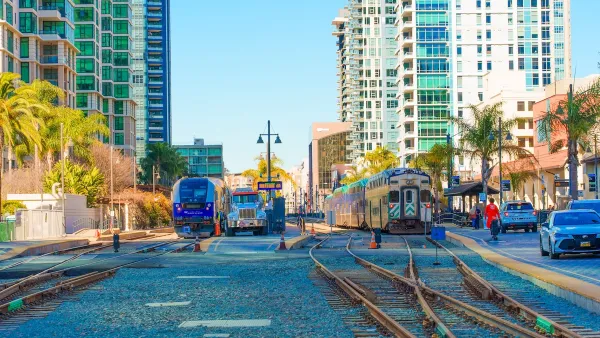
LA Opposes California Bill to add Housing Next to Transit Hubs
In a narrow vote, the city council voted to oppose SB79, a bill that would bypass local zoning laws to allow denser development near transit stops.

Planetizen Federal Action Tracker
A weekly monitor of how Trump’s orders and actions are impacting planners and planning in America.

California plans to bury El Niño’s downpour
If the state plays its cards right, it may be able to store a billion acre-feet of El Niño’s water in aquifers.

Desperate measures: Advocates weigh draining Lake Powell to fill Colorado River
Draining the reservoir could reduce evaporation losses by a couple hundred thousand acre-feet.

Mamdani’s pied-à-terre tax survives legal challenge
A panel of judges found that the plaintiffs failed to demonstrate injury as a result of New York City's implementation of the tax.

Eastern Nebraska is running out of electricity
Data centers and electrification are straining eastern Nebraska’s grid, throttling economic development.

Seattle passes record-breaking transit services expansion
Proposition 1 will double the city’s transit tax to add 95,000 more bus trips and preserve 180,000 bus trips annually.

FREE Course: Walkable City 1: Why Walkability?
After describing his path towards focusing on walkability as the essence of good planning, Jeff Speck marches through his five principal reasons for making more walkable places.
Reinventing Malls: Planning Alchemy—Turning Gray Fields Into Gold
The course focuses on the opportunities and imperatives that shape reinvention of mall sites.

City of Rosemead
Rutgers University, Edward J. Bloustein School of Planning and Public Policy
One Hundred Miles
University of Michigan School for Environment and Sustainability (SEAS)
Hunter College, City University of New York (CUNY)
The Architects Foundation
City of Cambridge
Montrose County
The Pocatello Development Authority