The closure of the Walter Reed Medical Center in Washington D.C. presents a big piece of property and a big opportunity for the District.


"The State Department will take a chunk of Walter Reed's 113 acres, possibly for embassies. But that leaves almost 70 acres for D.C. In a city where a quarter of the land is owned by the federal government, demand for land is high.
'This is a uniquely vocal community, let me just put it that way,' says Victor Hoskins, deputy mayor of Planning and Economic Development. He co-chairs the committee that is going to figure out just what the District of Columbia is going to do with all of this land.
'Actually, the interest we've gotten from a number of retailers already has been, really, quite astounding. What's going to happen is when that fence comes down [and] we develop the retail along there, it will become a place to go,' Hoskins says. 'And there's a chance now to revive a Main Street, which is Georgia Avenue, which has for years been suffering from decay.'"
The space will also no longer be exempt from property taxes, potentially created a big influx for the District.
Read the full story: Walter Reed Center's Closure May Be A Boon To D.C.
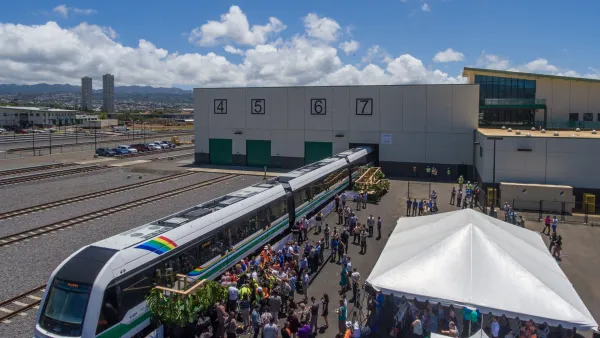
From robotaxis to robotrains: LA, DC weigh driverless transit
If approved, the projects will take years to implement and face financial and technical hurdles.
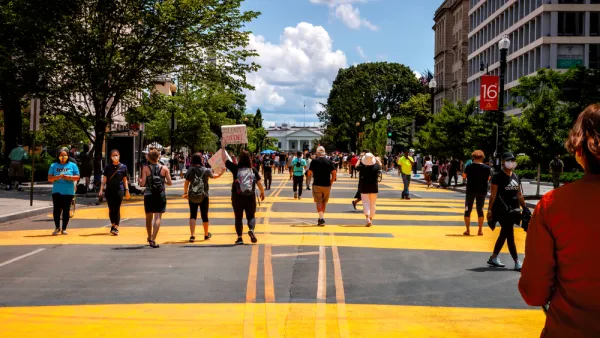
D.C. Revamps its Vision Zero Plan to Eliminate Traffic Fatalities
Washington, D.C. was an early adopter of Vision Zero in the United States, but eventually it became emblematic of the country's lack of progress in reducing traffic collisions.
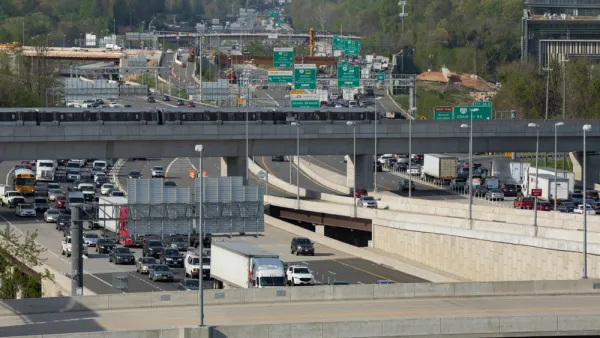
D.C. Region Sets Goal to Reduce GHG Emissions From Transportation 50% by 2030
Transportation is the largest source of greenhouse gas emissions in the D.C. region—and the rest of the country. The D.C. region is committing to drastic actions to change their ways, however.

Planetizen Federal Action Tracker
A weekly monitor of how Trump’s orders and actions are impacting planners and planning in America.

Eastern Nebraska is running out of electricity
Data centers and electrification are straining eastern Nebraska’s grid, throttling economic development.

Washington state to charge fee to drivers with fuel-efficient cars
Revenue from the fee will go towards supporting the state’s highways.

Instead of building new housing, LA developers are turning mansions into mega-mansions
In the richest areas, the number of houses valued at $30 million with demolition permits has skyrocketed since 2018.

Illinois considers spending $1 billion in taxpayer money on data center
A quantum computing campus and data center are currently under construction in Chicago.

As development costs rise, Boston moves to lessen affordable housing requirements
The Boston Zoning Commission and the City Council still need to approve Boston Mayor Michelle Wu’s proposed changes

FREE Course: Walkable City 1: Why Walkability?
After describing his path towards focusing on walkability as the essence of good planning, Jeff Speck marches through his five principal reasons for making more walkable places.
Reinventing Malls: Planning Alchemy—Turning Gray Fields Into Gold
The course focuses on the opportunities and imperatives that shape reinvention of mall sites.

City of Charlotte
City of Rosemead
Rutgers University, Edward J. Bloustein School of Planning and Public Policy
University of Michigan School for Environment and Sustainability (SEAS)
Hunter College, City University of New York (CUNY)
The Architects Foundation
University District Partnership
City of Cambridge
The Pocatello Development Authority