A decade after terrorist attacks looked to usher in an age of security-heavy architecture, new projects in cities are eschewing the security bunker for eyes and feet on the street.


This is especially true in Cleveland, where a series of new projects are emphasizing the importance of place.
"Whether it can help reverse the city's decline and attract visitors and new residents after decades of job and population loss is an open question. But it's clear that among the many forces shaping the projects, from a new burst of civic energy to the surging demand for rental apartments in the city, the fear of a terrorist attack is in most cases a distant concern.
"We're not trying to create bunkers, we're trying to create places that open up to the outside," said developer Ari Maron of MRN Ltd.
Major projects, from the renovation of the Cleveland Museum of Art to the city's new hospitals, convention center and medical mart, emphasize large civic spaces, transparency, ease of access and the free flow of ideas."
Read the full story: In braver new world of post-9/11 building, windows, 'eyes on street' trump blast walls

Rail Stations Shortchanged as Homeland Security Focuses on Airports
Rail travelers are not subject to the same degree of security measures as air travelers according to security experts, reports Ron Nixon for The New York Times. Yet far more travel by rail than plane, and rail has been a terrorist target abroad.

Building Secure Yet Welcoming Public Spaces
Strategies for securing public spaces from vehicle attacks and other acts of terrorism without sacrificing accessible, vibrant urban places.
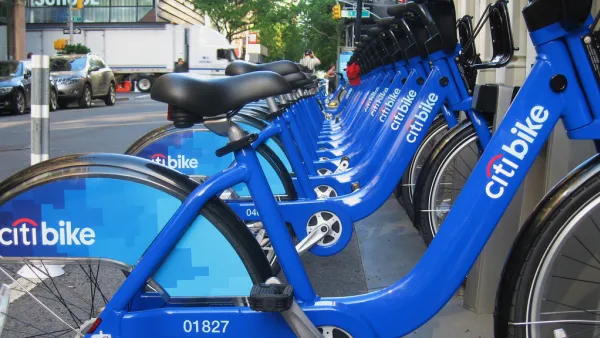
Citi Bikes Ingrained in Gotham, For Better or Worse
Six of the eight victims of the deadliest act of terrorism in New York since 9/11 were riding Citi Bikes. The same day, a bus driver was charged in the death of the bikeshare's first fatality. Two more Citi Bike-related deaths occurred this year.

Planetizen Federal Action Tracker
A weekly monitor of how Trump’s orders and actions are impacting planners and planning in America.

California plans to bury El Niño’s downpour
If the state plays its cards right, it may be able to store a billion acre-feet of El Niño’s water in aquifers.

Chicago breaks ground on $3 billion megadevelopment
The new neighborhood, titled Foundry Park, will one day host 3,700 residences.

California High-Speed Rail Authority CEO resigns after $600,000 scandal
Under Ian Choudri, the authority used taxpayer dollars to fund first class flights and trips to nightclubs.

Want to study the Missouri River? Soon, you may need unanimous approval from 10 states
Legislation would require 10 governors’ permission to study or build projects moving water outside the basin.

Desperate measures: Advocates weigh draining Lake Powell to fill Colorado River
Draining the reservoir could reduce evaporation losses by a couple hundred thousand acre-feet.

FREE Course: Walkable City 1: Why Walkability?
After describing his path towards focusing on walkability as the essence of good planning, Jeff Speck marches through his five principal reasons for making more walkable places.
Reinventing Malls: Planning Alchemy—Turning Gray Fields Into Gold
The course focuses on the opportunities and imperatives that shape reinvention of mall sites.

City of Rosemead
Rutgers University, Edward J. Bloustein School of Planning and Public Policy
One Hundred Miles
Hunter College, City University of New York (CUNY)
The Architects Foundation
University of Cincinnati Online
City of Cambridge
Montrose County
The Pocatello Development Authority